
Pick the wrong one and you pay for it in energy, seal wear, leakage risk, and unplanned downtime. Pumps account for 21% of industrial motor-system electricity, according to LBNL's 2021 assessment. That figure covers all pump types, not only centrifugal, but it shows why selection matters.
This guide explains how each design works, where each fits, and how to decide using duty data rather than impeller count.
Key Takeaways
- Single-stage pumps have one impeller; multistage pumps stack two or more in series to build head.
- Higher flow at low-to-moderate head favors single-stage; high head favors multistage.
- Match duty point, fluid, NPSH, materials, and lifecycle cost before you choose.
- Corrosive, toxic, abrasive, or hot fluids need extra review of materials and seals.
Single-Stage vs Multistage Centrifugal Pumps: Quick Comparison
| Factor | Single-stage | Multistage |
|---|---|---|
| Impellers | One | Two or more in series |
| Typical role | Lower head relative to flow | High head relative to flow |
| Complexity | Fewer internal parts | Added impellers, diffusers, interstage parts |
| Maintenance | Simpler access | More alignment and sealing sensitivity |
Architecture and operating principle
In a single-stage pump, one rotating impeller transfers energy to the liquid. The casing then slows the flow, converting velocity into pressure.
In a multistage pump, liquid passes through several impellers in series. Each stage adds energy, so total head accumulates. With identical stages at the same speed, stages add head and power, not flow.

Flow and head capability
Grundfos's handbook describes normal single-stage operation as roughly 7-330 feet of head, though catalog designs go beyond that. Sulzer's CPE single-stage line reaches 900 feet of head, while its MSD multistage line reaches 9,500 feet. Treat these as product examples, not universal limits. Always verify against the selected pump curve.
The stage count follows from the required total dynamic head.
Cost, maintenance, and efficiency
Single-stage pumps are simpler, easier to inspect, and need fewer spares. Initial cost is often lower for standard pressure requirements.
Multistage pumps add interstage components, seals, and alignment demands. They can deliver high head efficiently in the right application, but more stages are not automatically more efficient.
Oversizing hurts either type. The DOE flags flow differing by more than 30% from best-efficiency flow as a sign of incorrect sizing, a screening flag rather than a hard limit.
Fluid compatibility and installation
- Single-stage: end-suction, split-case, and inline configurations; materials and seals must match the fluid.
- Multistage: vertical or horizontal layouts; consider footprint, maintenance access, and pressure rating.
Neither design is inherently better for corrosive service. Wetted materials and sealing decide that.
What Is a Single-Stage Centrifugal Pump?
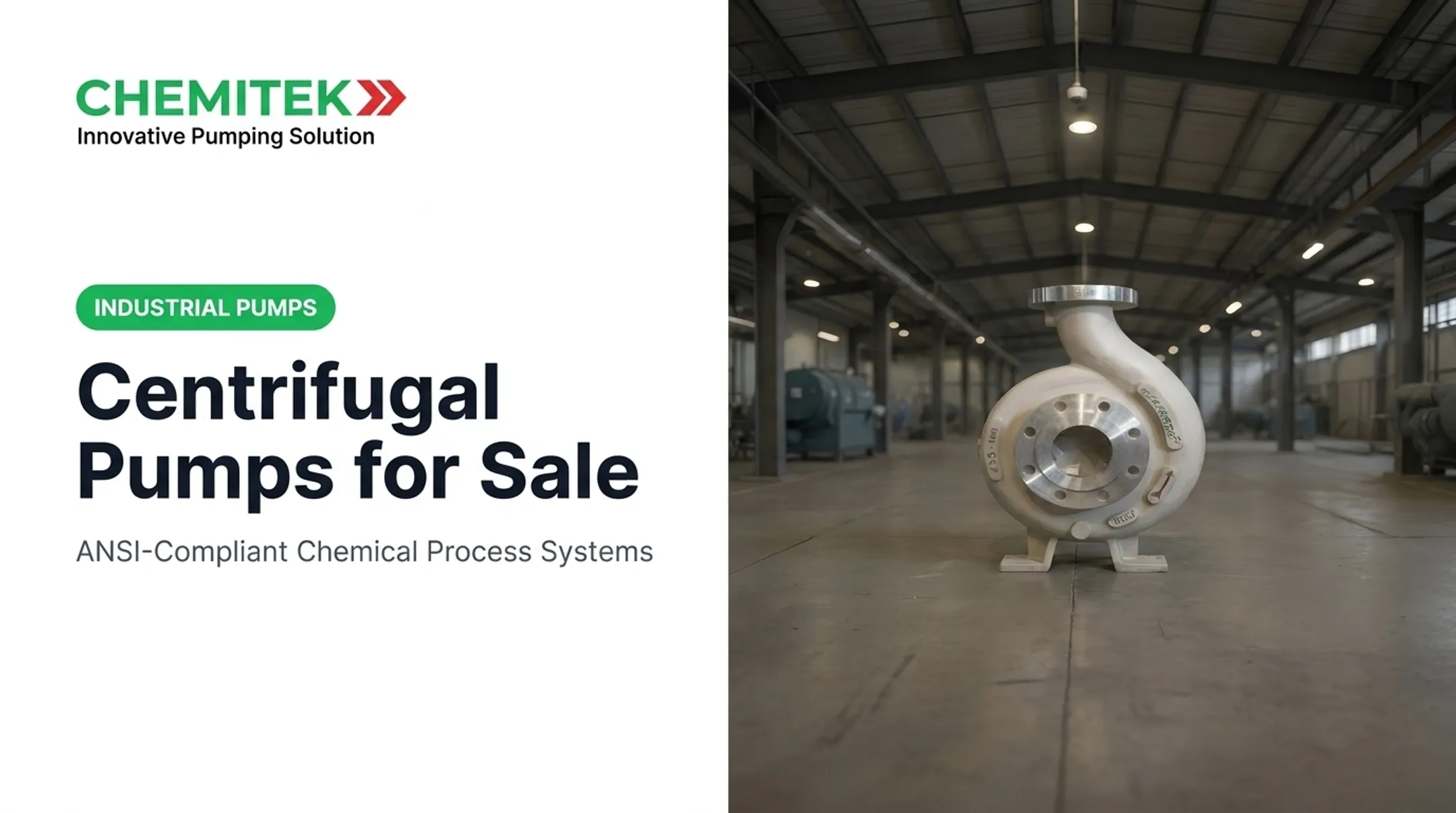
A single-stage pump has one impeller. Fluid enters axially through the suction nozzle, the impeller accelerates it outward, and the volute casing converts that kinetic energy into pressure at discharge.
Benefits
- Fewer internal components
- Easier inspection and maintenance
- Ideal for transfer, circulation, cooling, and many process duties
Limitations
- Impractical for very high head
- Running away from the best-efficiency region increases vibration, recirculation, seal wear, and energy use
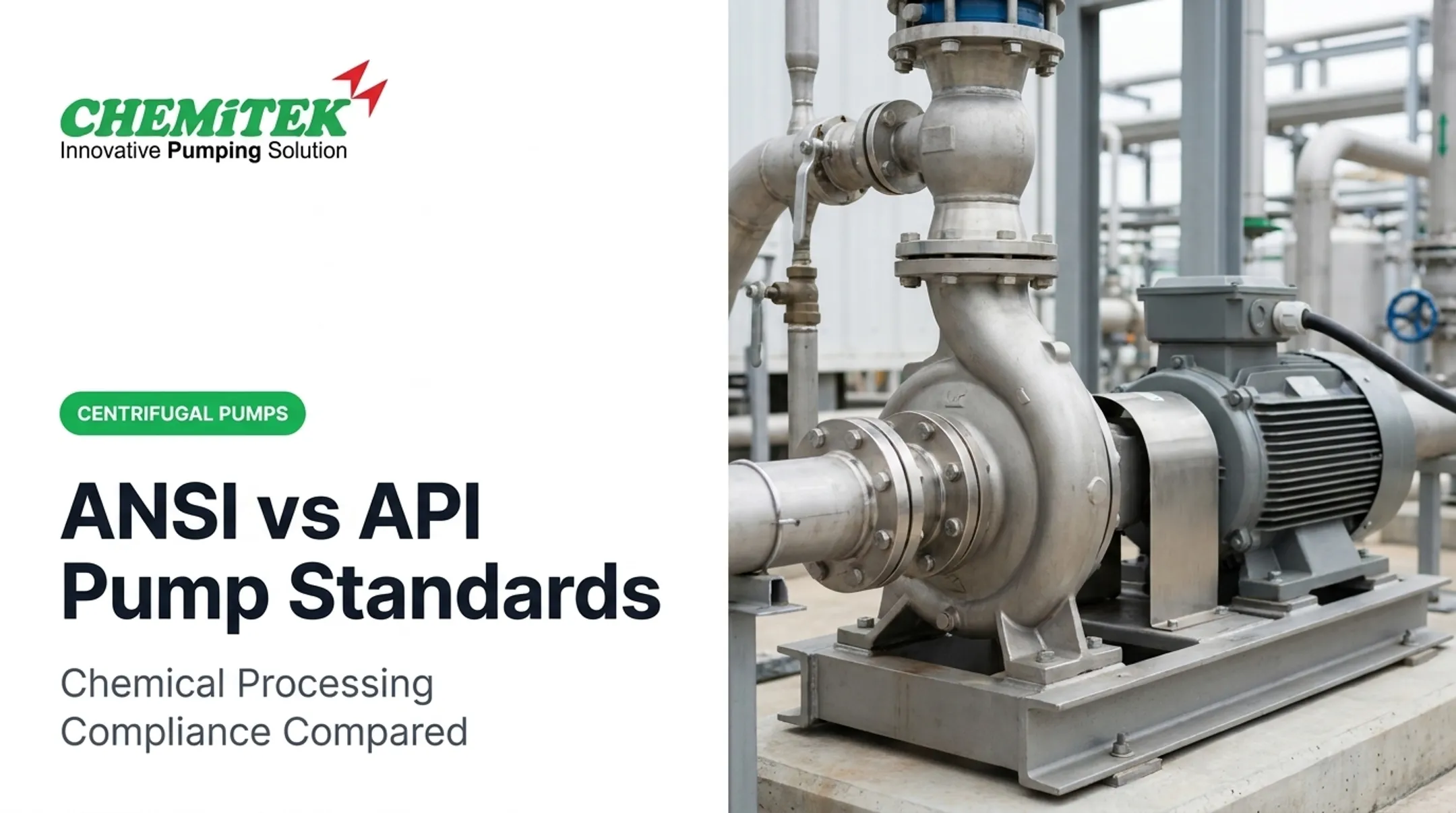
Chemitek's single-stage horizontal pumps reach flows up to 6,160 GPM and heads up to 394 ft, and are built to ANSI/ASME B73.1.
Use cases of single-stage pumps
Single-stage pumps fit high-flow or low-to-moderate head duties:
- Liquid transfer and cooling-water circulation
- HVAC and water treatment
- Acid circulation and alkaline-solution handling
- Fertilizer, dye, steel-plant, and specialty chemical process fluids
Chemical service only works when materials, temperature rating, and seals are verified for the specific fluid. ASME B73.1 covers single-stage, end-suction metallic and solid-polymer pumps and sets dimensional interchangeability. That standardizes installation, not chemical compatibility.
What Is a Multistage Centrifugal Pump?
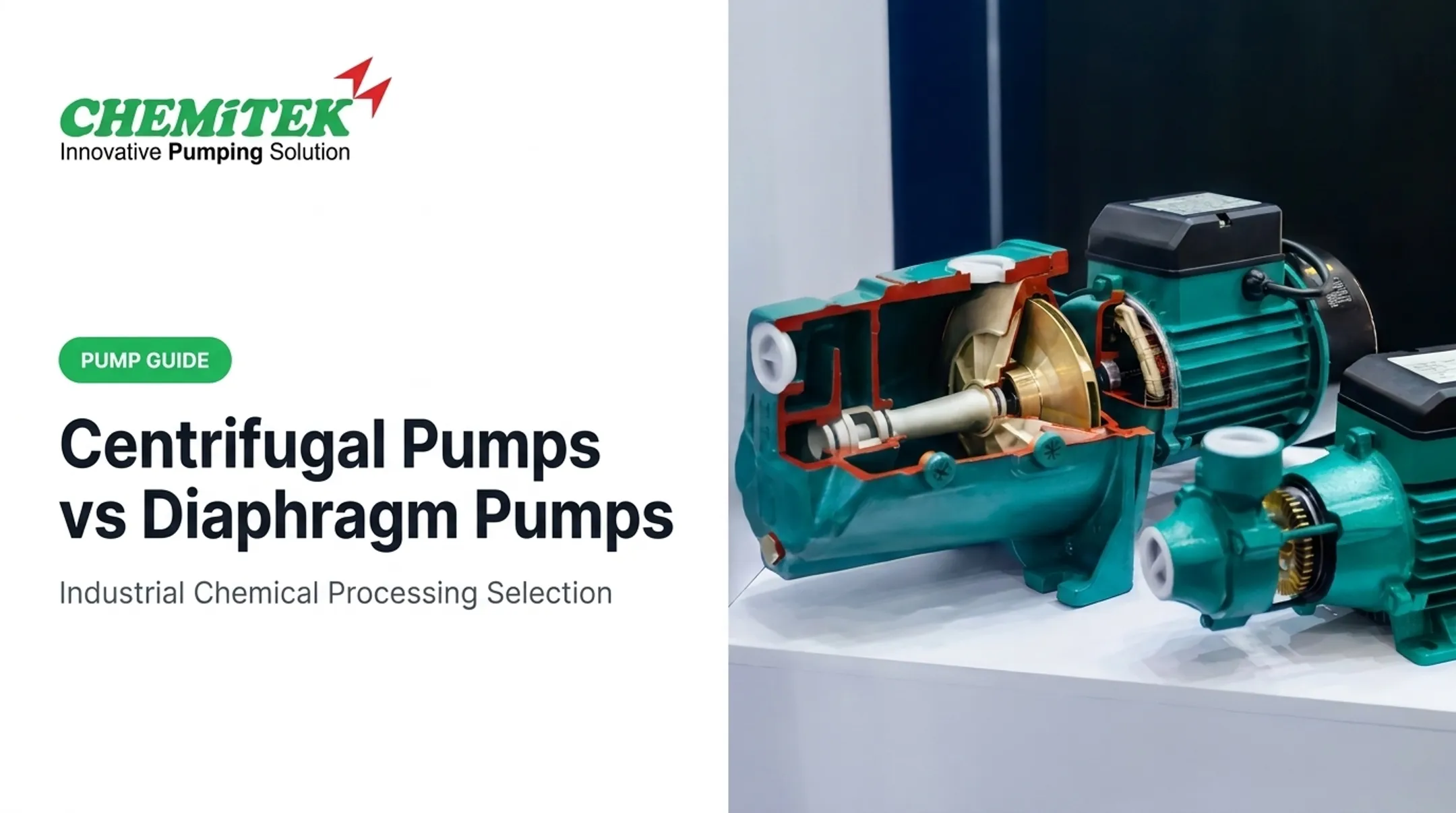
A multistage pump has two or more impellers on a common shaft. Liquid leaves one impeller and enters the next, so pressure builds progressively. Flow rate is still set by the pump and system curves.
Benefits
- High head from progressive pressure rise across stages
- Compact footprint for high-pressure duty
- Stronger efficiency than forcing one oversized impeller
Tradeoffs
- More complex construction
- Greater sensitivity to alignment and sealing
- More involved maintenance
KSB's guidance calls for alignment checks after installation or repositioning, since torque and thermal stress can shift alignment.
Use cases of multistage pumps
- Boiler feed and reverse-osmosis feed
- Pressure boosting and high-pressure water supply
- Mine dewatering and multilevel transfer
Multistage becomes relevant when one impeller would need an unsuitable speed, size, or curve position to reach the head. Per KSB, if speed cannot increase and a larger impeller would sacrifice efficiency, series stages are the economical route.
This article covers process pumps with impellers in series. Some two-stage fire pumps use a transfer valve to switch between parallel and series modes, which is a different arrangement.
Single-Stage vs Multistage: What Is Better?
Neither wins universally. Start with the duty point.
Collect duty data first
Gather this data before comparing:
- Required flow and total dynamic head
- Static elevation and friction losses
- Temperature, viscosity, and specific gravity
- Solids content and vapor pressure
- Operating hours and available NPSH
Keep NPSH margin in mind. NPSH3 marks a 3% head drop, not cavitation-free operation.
When each fits
Choose single-stage when:
- Flow and head sit within its efficient range
- Easy access and lower complexity matter
- The process needs substantial flow without extreme pressure
Choose multistage when:
- The system needs high discharge head or pressure boosting
- Elevation gain would push a single-stage pump outside a practical range
- High pressure matters more than maximum flow capacity

Compare lifecycle cost, not price
The DOE/HI/Europump lifecycle-cost framework covers purchase through disposal, including energy, maintenance, and downtime. In practice, compare:
- Motor power and energy use
- Seal and bearing replacement
- Spare-parts availability and maintenance labor
- Downtime exposure and footprint
Corrosive and toxic services
Wetted materials, mechanical seals, shaft protection, temperature capability, and containment all drive reliability. API 682 sets sealing requirements for hazardous, flammable, or toxic duties. Stage count alone does not determine the seal arrangement.
Chemitek offers custom design engineering and ANSI/ASME B73.1-compliant process pumps for demanding corrosive or toxic-liquid applications. Options include metallic pumps in titanium and Hastelloy, plus PVDF, PFA, and FEP non-metallic pumps. The final choice should rest on verified duty data, not a generic stage preference.
Real-World Examples and Case Studies
Phosphoric-acid filter feed
A phosphoric-acid plant selected a Sulzer single-stage end-suction pump with wear-resistant hydraulics, lower speed, and 654 SMO wetted parts. Parts life rose from 3-6 months to 12-24 months, and maintenance frequency fell by up to 75%, per Sulzer's case study. Energy and downtime savings were not quantified alongside those maintenance gains.
The gain came from hydraulic and materials selection, not from adding stages.
Eight-stage boiler-feed overhaul
At a Southeast Asian LNG plant, Sulzer overhauled eight-stage boiler-feed pumps at an unchanged 251 m³/h and 976.6 m head:
| Metric | As found | After overhaul |
|---|---|---|
| Efficiency | 64% | 74.2% |
| Power | 995.69 kW | 858.81 kW |

That shows efficiency recovery within a multistage design, not superiority over single-stage.
Takeaway
Each pump suited its duty, and neither result should be generalized. Condition, materials, and duty fit mattered more than stage count.
In Chemitek's steel-industry work with AMNS India, high spare-parts consumption was the core challenge. If you handle corrosive, toxic, high-temperature, or difficult process fluids, contact Chemitek for an application review and a custom pump recommendation.
Conclusion
Single-stage pumps are often the practical choice when flow and head fit one impeller's efficient range. Multistage pumps become relevant when the system demands substantially higher head.
The best choice rests on lifecycle performance, fluid compatibility, NPSH, maintenance access, energy use, and verified pump-curve data, not purchase price or pump type alone.
Frequently Asked Questions
What is a single-stage centrifugal pump?
It is a centrifugal pump with one impeller. The motor spins the impeller, which accelerates the liquid, and the casing converts that velocity into pressure and flow.
What is the main difference between a single-stage and a multistage centrifugal pump?
Single-stage has one impeller; multistage has several in series. Multistage designs reach higher head but add complexity, while single-stage suits simpler, higher-flow duties.
What is the most efficient type of pump?
No type is universally most efficient. Efficiency depends on the fluid, duty point, pump curve, motor, controls, and system design.
What are the three types of centrifugal pumps?
Classifications vary. By flow direction, Hydraulic Institute groups rotodynamic pumps as radial, mixed, and axial flow, though only radial-flow pumps are strictly centrifugal. Stage count and installation are separate classifications.
How does a multistage centrifugal pump work?
Liquid moves through successive impellers in series. Each stage adds energy, and the stages together set the pump's total head.