
The stakes are real. An IChemE/Chevron presentation identifies seal leaks as the most common reported pump failure mode in AFPM event-sharing data. One chemical plant case logged 18 pump removals for seal leakage in 18 months.
This article compares centrifugal, positive displacement, diaphragm, magnetic-drive, and specialized pumps. It then shows how to match each to an application.
Key Takeaways
- Select a pump for the liquid and the duty, not the "chemical service" label.
- Centrifugal pumps suit high-flow transfer; positive displacement and diaphragm pumps suit dosing, viscosity, or pressure.
- Sealless designs cut leak exposure but still need compatible materials and dry-run protection.
- Check flow, head, viscosity, temperature, solids, NPSH, seals, and lifecycle cost before buying.
What Are Chemical Pumps and Why Are They Important?
A chemical pump is engineered or configured to move chemical liquids safely and reliably. Its wetted materials, seals, hydraulics, and drive arrangement must withstand the fluid and process conditions.
Typical uses include:
- Tank transfer and process circulation
- Chemical injection and reactor feed
- Filtration and scrubber service
- Wastewater treatment and effluent handling
Why Chemical Pump Selection Matters
The right pump gives stable flow, accurate dosing, lower leakage risk, corrosion resistance, and less unplanned downtime. It also protects the product and surrounding equipment.
The wrong one shows up fast:
- Seal failure and corrosion
- Cavitation and excessive wear
- Inaccurate dosing
- Contamination and overheating
- Premature maintenance
A DOE/HI/Europump guide names energy, maintenance, and lost production as major lifecycle cost drivers. Energy often dominates above 2,000 operating hours per year.
Types of Chemical Pumps
Pumps are classified by operating principle and construction. No single type fits every combination of chemical, flow, pressure, temperature, and solids content.
Centrifugal Chemical Pumps
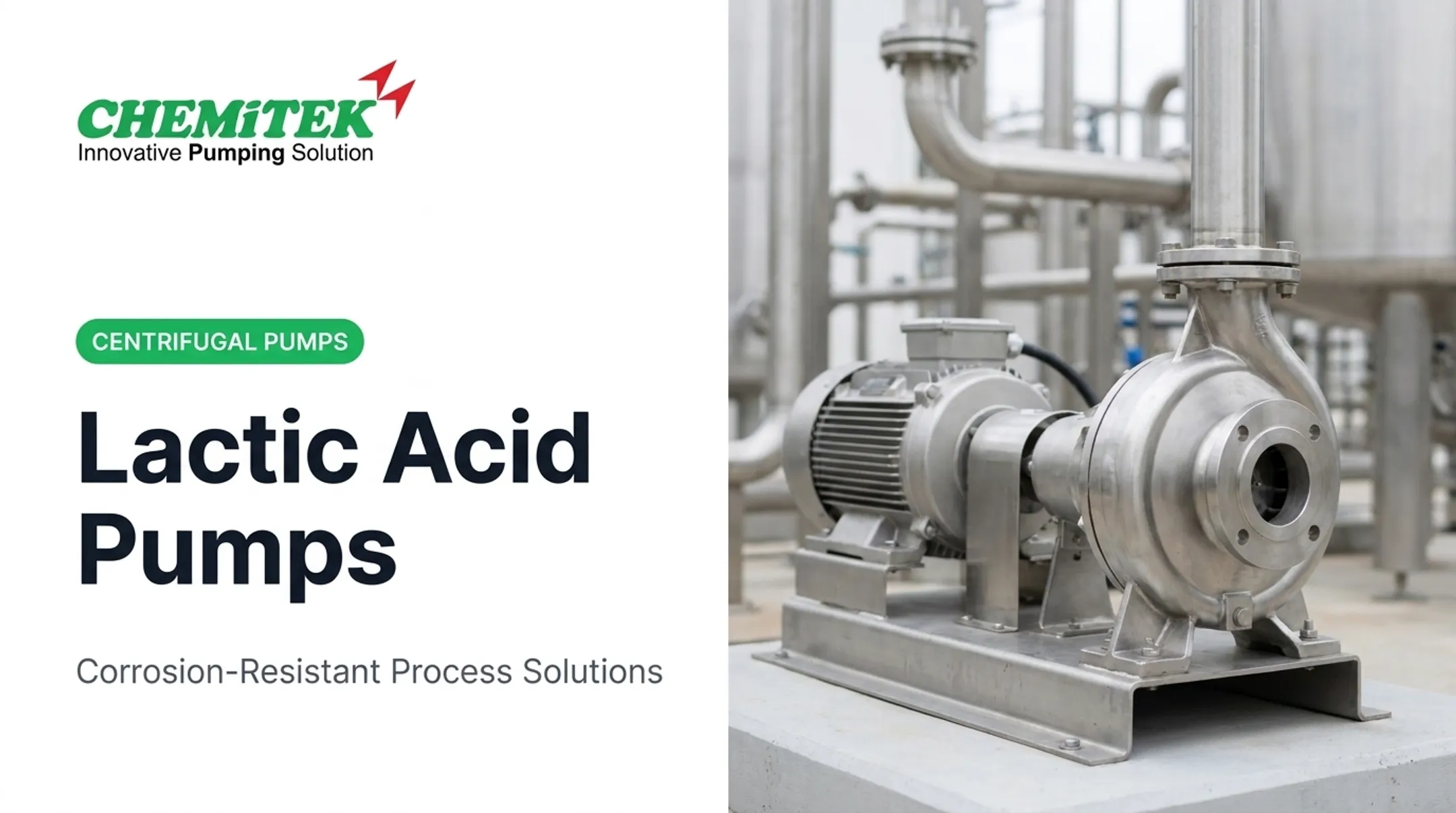
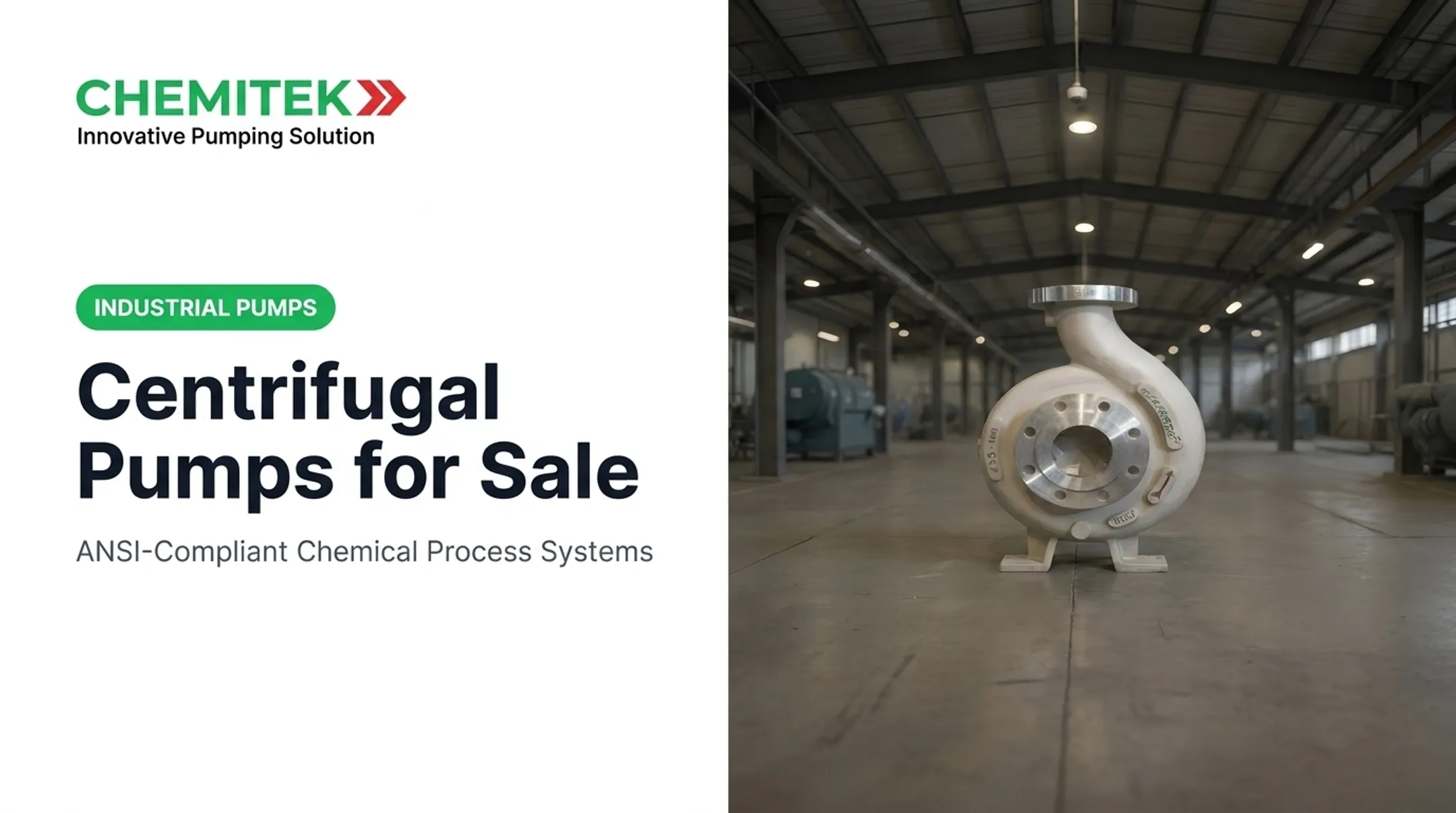
A centrifugal pump is a dynamic pump. A rotating impeller adds velocity to the liquid, and the casing converts that velocity into pressure.
It suits continuous transfer and circulation of relatively low-viscosity liquids at higher flow rates, provided the pump curve, NPSH, and chemical compatibility are right.
- Common uses: acid and alkali transfer, process circulation, cooling, scrubber service, wastewater, plant transfer lines
- Limits: very viscous liquids, precise low-flow dosing, poor suction conditions, dry running
Viscosity matters more than people expect. Viscous liquids reduce head, flow, and efficiency while raising input power, so water-based curves need correction.
NPSH3 marks a 3% head loss, not a cavitation-free point. You need margin above it.
Chemitek supplies custom-designed horizontal centrifugal process pumps in metallic and non-metallic builds for corrosive service. Match flow, temperature, and material ratings to the duty using current product data.
Positive Displacement Chemical Pumps
Positive displacement (PD) pumps capture a specific volume of liquid and move it from suction to discharge each cycle or rotation. There are two broad groups:
- Rotary: gear, screw, lobe, and vane designs
- Reciprocating: piston, plunger, and diaphragm designs
Because displacement stays consistent as system pressure changes, PD pumps suit metering, high-pressure service, and viscous liquids.
Key trade-offs:
- Rotary PD pumps need pressure-relief protection, since a blocked discharge can quickly exceed ratings
- Solids and abrasives wear close-clearance designs
- Reciprocating models pulsate
Most air-operated double-diaphragm pumps are an exception and can deadhead, but that is not a rule for all PD designs.
Diaphragm and Chemical Dosing Pumps
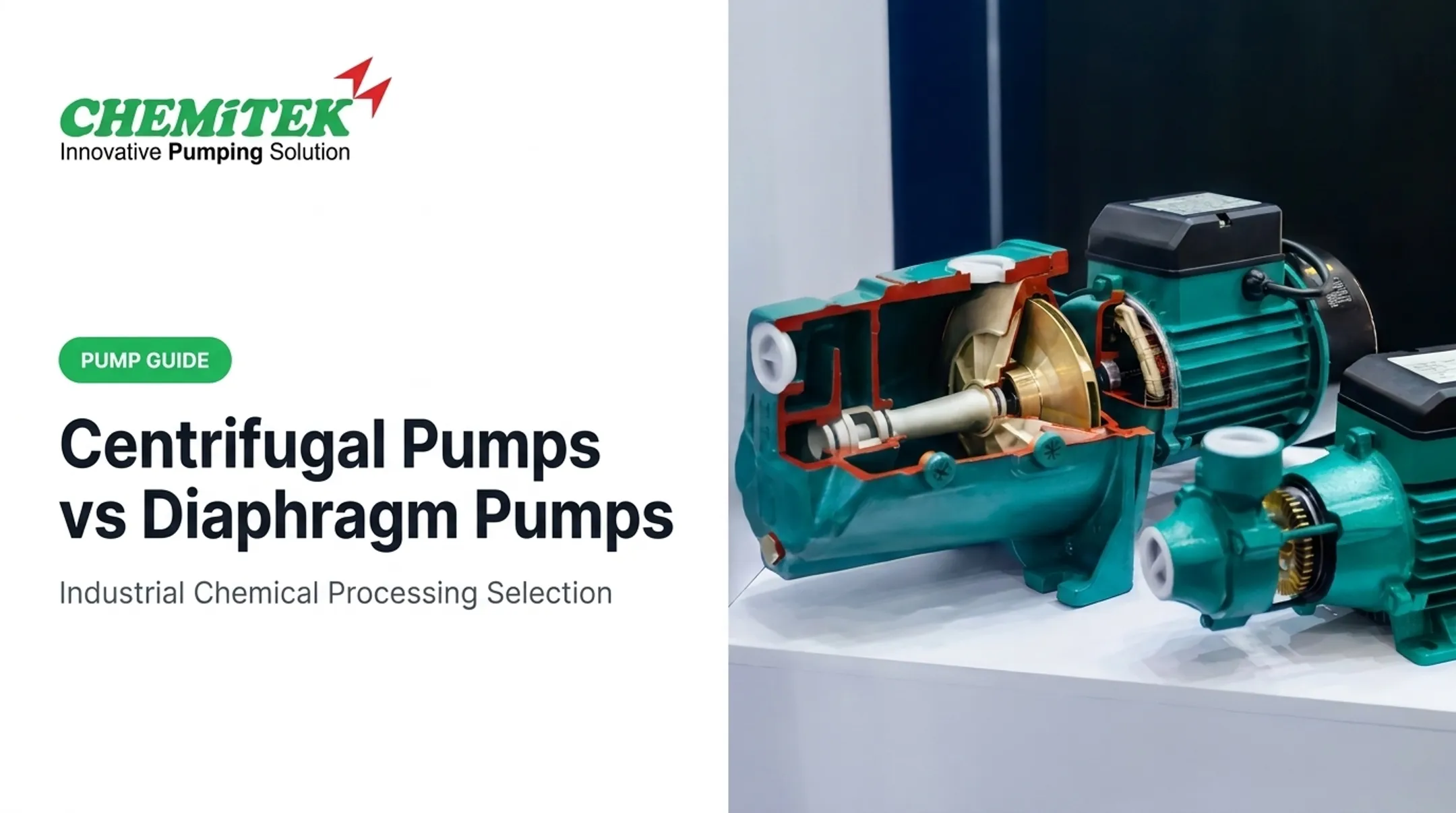
A diaphragm pump uses a flexible diaphragm and check valves to create suction and discharge. The diaphragm separates the pumped liquid from the drive.
Metering versions adjust stroke length, stroke frequency, or speed to deliver a measured dose. Under API 675, controlled-volume pumps specify a minimum 10:1 turndown and ±1% steady-state accuracy over the specified range, per Milton Roy.

Typical applications:
- Water-treatment chemical feed, pH adjustment, disinfection, coagulation, flocculation
- Reactor feed and solvent transfer
- Corrosive or abrasive liquid handling
Selection checks include:
- Diaphragm material and chemical compatibility
- Accuracy, pressure range, and pulsation control
- Valve design, overpressure protection, and dry-run safeguards
Magnetic-Drive and Other Sealless Chemical Pumps
In a magnetic-drive pump, magnets transmit motor torque to the impeller across a containment barrier. No dynamic shaft seal is exposed to the liquid. Canned-motor pumps are the other main sealless type.
That makes them useful for toxic, volatile, or leak-sensitive liquids. It does not remove the need for compatible wetted materials and proper controls.
Suitable duties include closed-loop circulation, chemical transfer, plating solutions, and solvent handling.
Limits to confirm:
- Dry running can damage bearings and bushings
- Heat generation, and vapor lock if the liquid flashes
- Solids sensitivity, depending on design
- Minimum flow and temperature conditions
Specialized Options for Difficult Chemical Duties
These are application-specific options, not interchangeable categories. None is universally best.
| Type | Fits | Watch for |
|---|---|---|
| Peristaltic | Isolated fluid path, metering | Hose fatigue and compatibility |
| Progressive-cavity | Viscous, solids-bearing, shear-sensitive fluids | Dry running; abrasive wear |
| Gear | Controlled transfer of compatible viscous liquids such as resins | Pigments and abrasion |
| Screw | Low-pulsation, gentle handling of polymers and resins | Material choice for aggressive liquids |
| Multistage centrifugal | Higher head | Not a different operating principle |
| Self-priming | Evacuates air from suction piping | Not a dry-running rating |
For example, a five-stage pump is normally a multistage centrifugal with five impellers in series. Extra stages build head, not proportionally more flow.
Chemical Pump Applications
Chemical Transfer and Process Circulation
Pumps move acids, alkalis, solvents, intermediates, and polymers between storage tanks, reactors, filters, heat exchangers, and production lines. Continuous, higher-flow duties usually go to well-selected centrifugal pumps. High viscosity, high pressure, or tight leakage limits favor other pump types.
Chemical Dosing, Metering, and Feed
Dosing pumps inject treatment chemicals, catalysts, pH-control chemicals, coagulants, flocculants, and disinfectants. Key requirements include:
- Adjustable, repeatable flow
- Good check valves and regular calibration
- Pulsation control
- Compatibility with concentration and temperature
Hazardous, Corrosive, and Toxic Liquid Handling
Priorities include:
- Corrosion-resistant wetted parts
- Suitable liners or polymers
- Leak-minimizing seals and secondary containment
- Leak detection
- Hazardous-area compliance where applicable
Keep compatibility and mechanical suitability separate. A material may resist the chemical yet fail on temperature, pressure, abrasion, or vacuum.
Viscous, Abrasive, and Solids-Bearing Chemicals
Viscosity, crystals, pigments, and slurries affect clearances, impeller choice, wear, shear, and clogging risk. Rotary PD, diaphragm, and progressive-cavity pumps are candidates, but only after you check actual particle size, concentration, viscosity, and duty cycle.
A fertilizer example from Sulzer's case study shows the cost of getting this wrong. Hot, corrosive, abrasive fluorine-salt liquid gave the original pump about three months of life against a one-year target, and three material trials followed.

Industry and Treatment Applications
- Water treatment: hypochlorite disinfection, acid/caustic pH control, coagulant and polymer feed
- Steel pickling and plating: hydrochloric and sulfuric acid handling, tank transfer
- Specialty chemicals and fertilizers: reactor feed, caustic transfer, acid unloading
- Pharmaceuticals: shear-sensitive product transfer
- Effluent treatment: additive metering, wastewater, sludge
The industry name alone is not enough. Identify the exact liquid, process stage, schedule, flow, pressure, temperature, and safety requirement.
How to Choose the Right Chemical Pump
The right pump depends on duty and risk profile, not popularity, price, or the fanciest design.
Fluid Characteristics to Document
Record:
- Composition, concentration, pH, specific gravity
- Viscosity, vapor pressure, temperature
- Flammability and toxicity
- Solids, abrasiveness, crystallization, shear sensitivity
Review compatibility for every wetted part: casing, impeller, liner, shaft, elastomers, diaphragm, seal faces, gaskets, and connections. Ratings in guides such as Graco's are typically given at 70°F and are guidance, not a guarantee.
Hydraulic and Operating Requirements
Define these operating points up front:
- Flow, total dynamic head, and discharge pressure
- Suction conditions, NPSH available, and pipe size
- Duty cycle, minimum flow, and future capacity changes
Evaluate pump curves and system curves together. Centrifugal suits high flow at low to medium head. Multistage adds head. Positive displacement (PD) and dosing pumps suit controlled flow or high pressure.

Materials, Seals, and Leak Control
Options include metallic, non-metallic, lined, and engineered polymers. No material works for every chemical. Polymer temperature limits belong to a specific construction; one manufacturer lists PP at 180°F and PVDF at 220°F, application-dependent.
Seal choice follows hazard level. API 682 defines three arrangements:
| Arrangement | Configuration |
|---|---|
| 1 | Single seal |
| 2 | Dual seal, unpressurized buffer |
| 3 | Dual seal, pressurized barrier |
Magnetic-drive, diaphragm, containment, and leak-detection options also scale with hazard.
Safety, Standards, and Installation Conditions
Review:
- Hazardous-area classification (NEC Articles 500 and 505; OSHA 1910.307)
- Motor and electrical requirements
- Pressure relief, secondary containment, ventilation, grounding
- Instrumentation and isolation valves
OSHA 1910.119 process safety management applies only to processes meeting its criteria, though pumps are included in covered mechanical-integrity equipment. For hazardous-waste tank systems, 40 CFR 264.193 excepts sealless pumps inspected daily from secondary containment.
Have qualified engineering and safety personnel review US codes and site procedures. This overview is not design approval.
Lifecycle Cost and Maintainability
Compare the full ownership picture:
- Energy use and spare-parts demand
- Seal or diaphragm replacement intervals
- Inspection access and corrosion allowance
- Repair availability, service life, and operator skill
- Downtime cost when the pump is offline
A higher purchase price can pay off if it cuts leakage exposure, maintenance, product loss, or outages.
What to Check Before Finalizing a Chemical Pump Type
Avoid these mistakes:
- Choosing the most advanced pump when a simpler one meets the duty
- Selecting by familiarity
- Relying on a nominal flow rating alone
Before you finalize, confirm:
- Pump curve fit and NPSH margin
- Materials plus seal or containment arrangement
- Temperature and pressure limits
- Dry-run protection, solids tolerance, and controls
Where custom work is justified, Chemitek's custom design engineering and process-pump experience can be evaluated against the documented duty. Use current technical data to confirm suitability rather than assuming a standard model fits.
Conclusion
Chemical pumps safely transfer, circulate, dose, or pressurize demanding liquids. Centrifugal, positive displacement, diaphragm, magnetic-drive, multistage, and specialized designs each serve different mixes of flow, pressure, viscosity, solids, leakage risk, and compatibility.
Document the fluid, hydraulic duty, materials, safety conditions, and lifecycle needs first. That is what leads to a reliable, economical decision.
Frequently Asked Questions
How does a chemical dosing pump work?
A diaphragm, piston, or similar mechanism draws in and discharges a controlled volume through check valves. Stroke length, stroke speed, calibration, and system pressure determine the delivered dose.
What are the major types of chemical pumps?
The main types are centrifugal, positive displacement, diaphragm or metering, magnetic-drive or sealless, and specialized designs. The best option depends on the liquid and the duty.
What is a 5 stage pump?
It is generally a multistage centrifugal pump with five impellers in series to develop higher head. Chemical compatibility, flow, NPSH, and temperature still decide suitability.
Which pump is best for corrosive chemicals?
It depends on the chemical, concentration, temperature, pressure, flow, and leakage risk. Verify materials and seal or sealless design against compatibility data.
What factors should be considered when selecting a chemical pump?
Consider chemical properties, flow, head, pressure, viscosity, temperature, solids, NPSH, materials, seals, safety classification, controls, maintenance, and lifecycle cost.