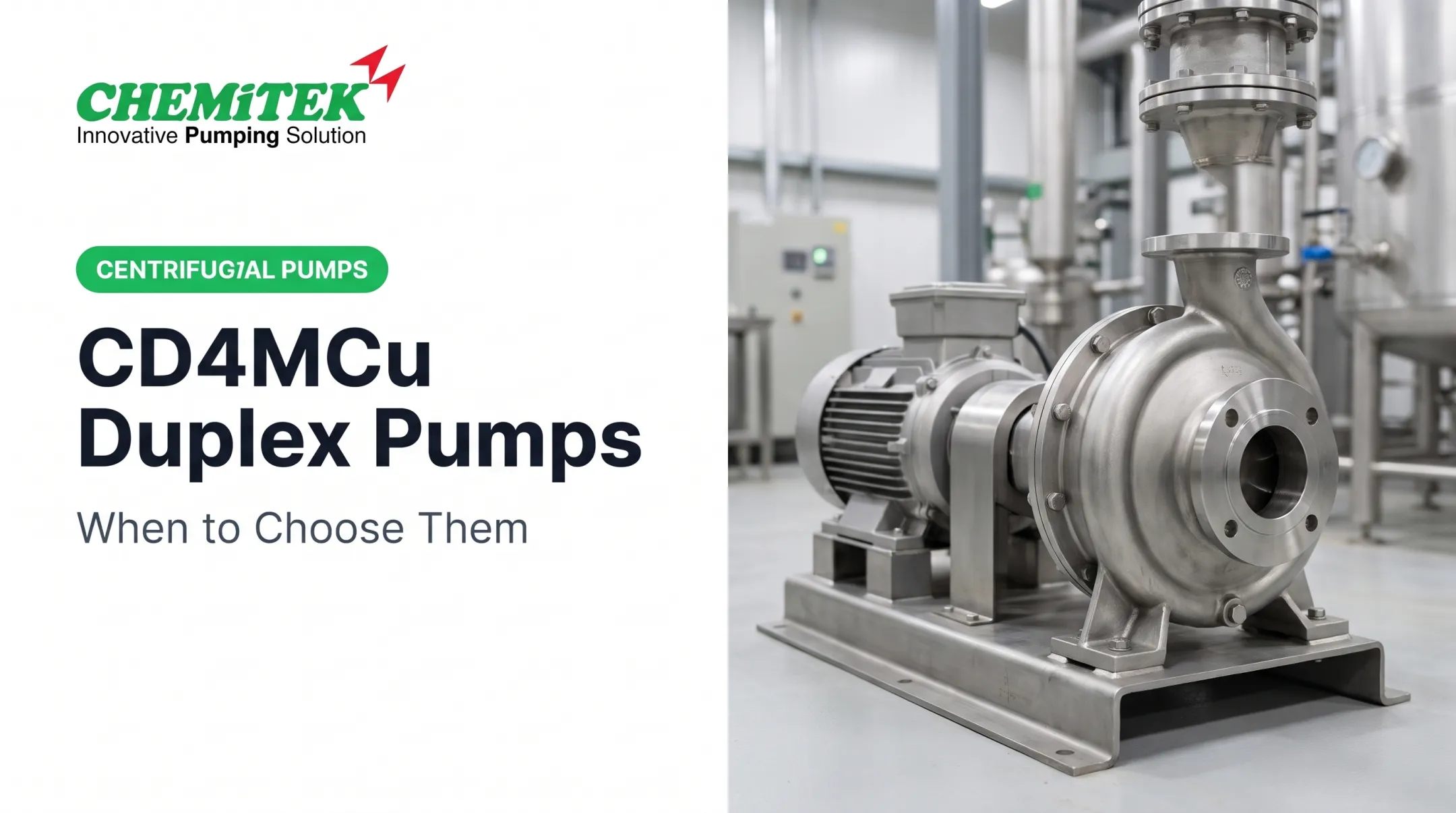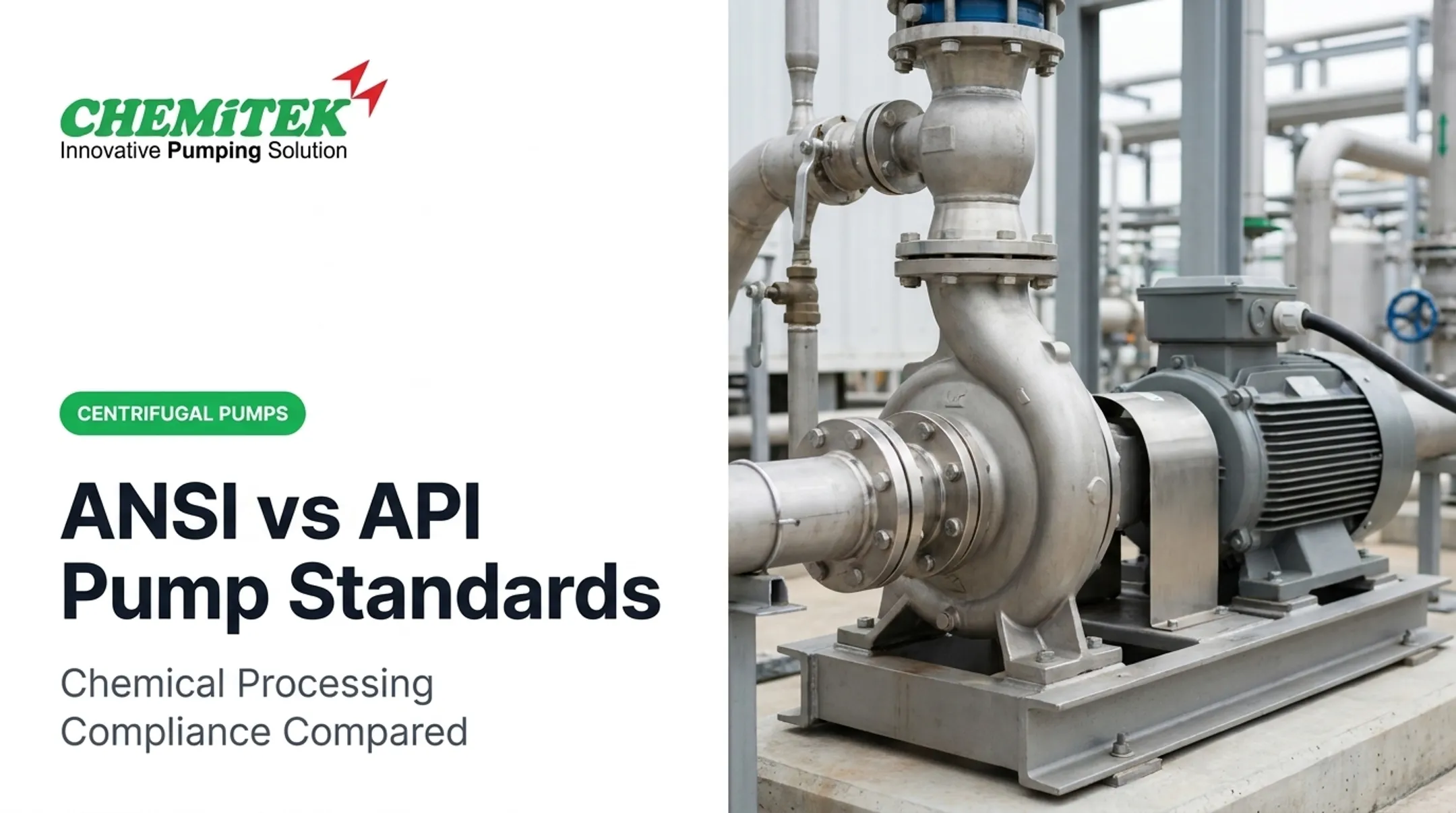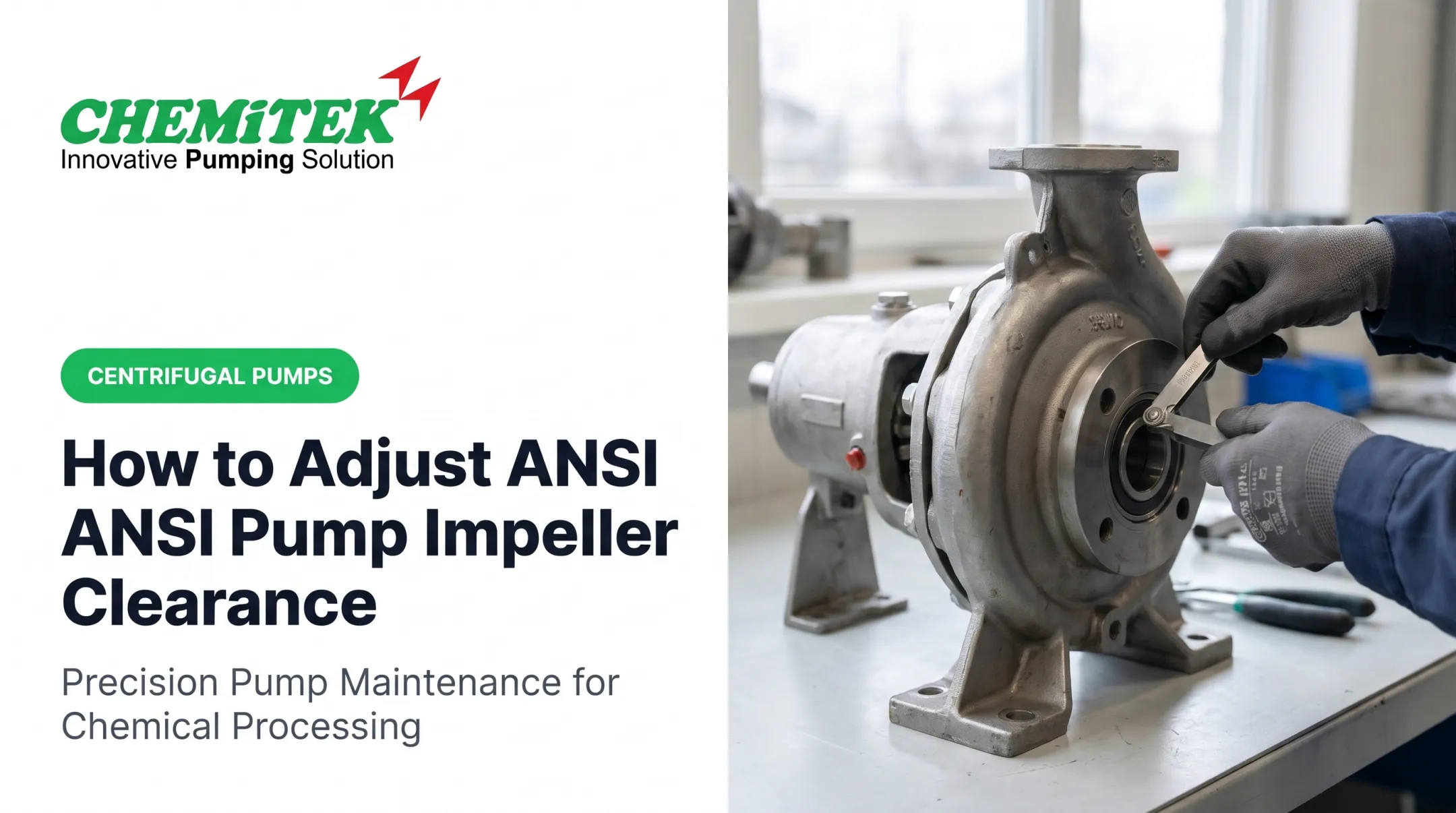

Fit is only one question, though. A pump that drops in cleanly can still have the wrong hydraulics, materials, or seals for your fluid.
This article covers what the standard specifies, which specifications to review, how compliance is validated, and where compliance stops and application engineering starts.
Key Takeaways
- ASME B73.1 standardizes installation interfaces for horizontal, end-suction, single-stage chemical process pumps.
- Matching dimensions eases replacement but does not guarantee matching hydraulics, materials, or seals.
- Selection depends on the full duty: flow, head, fluid, temperature, pressure, solids, and system curve.
- Confirm the standard edition, certified drawings, and test records before approving a pump.
What ANSI B73.1 Specifies
The standard and its scope
ASME lists the current edition as ASME's B73.1-2026, Specification for Horizontal End Suction Centrifugal Pumps for Chemical Process. It covers metallic and solid-polymer pumps that are horizontal, end suction, single stage, with centerline discharge.
Its stated purpose is dimensional interchangeability, plus design features that ease installation and maintenance and improve reliability and safety. ASME administers the standard through a consensus process, and ANSI accredits it. That is why the "ANSI" label stuck.
Cite the edition in your specifications. "ANSI pump" alone is not a date-controlled reference.
What interchangeability covers
For the same dimension designation, the standard addresses:
- Mounting dimensions
- Suction and discharge nozzle sizes and locations
- Input shafts
- Baseplates
- Foundation bolt holes
This is installation interchangeability. Individual internal parts are not necessarily interchangeable between manufacturers, so verify spares compatibility before you assume a swap.
What it does not promise
The public scope does not guarantee efficiency, seal life, or chemical compatibility. Two nominally compliant pumps can behave differently because of impeller hydraulics, materials, tolerances, seal configuration, operating point, fluid chemistry, and maintenance condition.
Terminology to watch
- "ANSI pump" is an industry category label used by manufacturers.
- "B73.1-compliant" is a conformity claim. Ask what it covers.
- "Meets B73.1 dimensional standards" claims dimensional conformity only.
Manufacturers word these differently. Read the actual claim, and do not treat informal terminology as proof of full compliance.
Core Pump Specifications Defined by ANSI B73.1
Read the specification categories together. Dimensional fit matters only if the pump also meets the hydraulic, mechanical, and material needs of the service.
Dimensional and Interface Requirements
Compare these items on the certified drawing, not the brochure:
- Nozzle sizes and locations
- Foundation bolt pattern and baseplate dimensions
- Shaft and coupling interfaces
- Overall envelope and maintenance clearances
Manufacturers publish size designations such as 1 x 1-1/2 - 6 or 1-1/2 x 3 - 6 (Goulds uses codes like AA and AB for these). Matching the designation lets you avoid piping changes, re-grouting, and motor swaps. It also affects alignment, coupling selection, and spare-parts planning.
Hydraulic and Operating Specifications
The pump data sheet should record:
- Flow, head, and speed
- Suction pressure, NPSHA, and NPSHR
- Efficiency, rated power, and maximum power
- Impeller diameter
- Minimum continuous stable flow and best efficiency point (BEP) flow
Evaluate the pump curve against your actual system curve. An ANSI designation says nothing about whether the duty point sits near BEP.
The Hydraulic Institute defines the preferred operating region as the flow range around BEP where efficiency and reliability are not substantially degraded. A wider allowable region exists, but the manufacturer determines its limits.
Materials, Seals, and Mechanical Construction
Fluid composition, concentration, temperature, abrasiveness, solids, and corrosion risk drive material choices for the casing, impeller, shaft, wear parts, gaskets, and seals. The dimensional standard does not make these choices for you.
Specify separately:
- Seal arrangement, faces, and elastomers
- Lubrication and bearing design
- Shaft protection and containment needs
Metallic options from one major manufacturer include 316SS, CD4MCuN, Alloy 20, Monel, nickel, Hastelloy B/C, and titanium. Availability is not a corrosion ranking, so check compatibility for your actual fluid and concentration.
Pressure, Temperature, and Design Boundaries
Pressure-temperature capability, allowable nozzle loads, and vibration limits come from the manufacturer's certified design data and the applicable edition. They do not come from the phrase "ANSI pump." A nameplate pressure rating, for instance, is stated at a specific temperature and is not a universal B73.1 limit.
Keep these conditions distinct:
- Continuous operating conditions
- Transient conditions
- Hydrostatic test conditions
- Upset or emergency conditions
Material ratings and assembled-pump ratings also differ. Chemours reports PFA resin capability to 260 °C, yet Flowserve's PolyChem S, a PFA-lined pump, has a published envelope of -30 to 150 °C. The pump limit governs.

For corrosive chemical service, expect custom or non-metallic materials even when installation dimensions follow B73.1.
How ANSI B73.1 Specifications Are Selected and Validated
Treat B73.1 as both a procurement reference and a verification tool. You translate process conditions into a complete data sheet, then confirm delivered equipment against approved documents.
Building the Pump Specification
Your specification checklist should cover:
- Liquid name, chemistry, concentration, and specific gravity
- Flow range, head or pressure, and viscosity
- Temperature and vapor pressure
- Solids content and maximum particle size
- Suction conditions and elevation
- Operating hours and control method
- Area classification
- Materials, seal plan, and motor requirements
- Startup and upset conditions
State mandatory standard compliance separately from optional features. Call out each add-on as its own line item:
- Self-priming or close-coupled construction
- Special impellers
- Double seals
- High-temperature service
- Corrosion-resistant materials
Reviewing Drawings and Documents
Before approval, review:
- Completed data sheet and performance curve
- General arrangement and certified dimensional drawings
- Sectional drawing and materials list
- Seal, motor, and coupling details
- Baseplate information
- Inspection and test plan, and the operating manual
Then compare certified dimensions and nozzle loads against your existing piping, foundation, motor, coupling, and maintenance clearances before ordering.

Testing and Acceptance
ASME's public data sheet separates hydrostatic and leak tests, performance and NPSHR tests, and vibration and bearing-temperature checks. It also covers mill test reports for casing, cover, impeller, and shaft.
Each test has non-witnessed, witnessed, or certificate options. Confirm which your purchase specification requires, because not every order includes every test.
Label values clearly:
| Value type | Meaning |
|---|---|
| Rated | Catalog or data-sheet duty conditions |
| Guaranteed | Contractually agreed duty point at rated speed |
| Tested | Measured results, evaluated against a stated acceptance grade |
Hydraulic Institute's ANSI/HI 14.6-2022 covers hydraulic performance acceptance testing and its grades. Agree on the grade up front. Do not mix catalog data with acceptance data.
Applying the Standard to Process-Pump Selection
A B73.1 design is a sound starting point for chemical, specialty chemical, pharmaceutical, water-treatment, and steel applications. The final selection still depends on the actual fluid and system duty.
Chemitek offers ANSI/ASME B73.1-compliant pump designs with custom engineering and metallic or non-metallic material options for demanding corrosive-process service. Its published specifications list flow up to 4,400 GPM (1,400 m³/hr), head up to 394 ft (120 m), and working pressure up to 363 psi (25 bar). Review the manufacturer's application-specific data and certified drawings for your duty, not a general claim.

A replacement scenario
Say a plant replaces a failed pump with a dimensionally matching unit from another supplier. The matching designation may avoid piping and foundation changes. The engineer must still confirm:
- Hydraulic curve against the system curve
- Shaft power and motor rating
- Seal type and materials
- Rotation direction
- Minimum flow and operating limits
Skipping these checks is how a "direct replacement" becomes a repeat failure.
Operating Risks and Common Misinterpretations
What happens off the preferred range
The Hydraulic Institute links operation outside the preferred region to recirculation, flow separation, added loading, flow-induced vibration, and local cavitation. NPSH3 corresponds to a 3% head drop, so running with NPSHA at NPSH3 already means cavitation-related loss.

Manufacturer guidance adds more. Goulds warns that running outside rated flow can cause high vibration, seal or shaft failure, or loss of prime. A blocked or closed discharge can heat and vaporize the liquid quickly.
Typical damage includes:
- Damaged seals and bearings
- Worn impellers and casings
- Motor overload
- Shorter service life
Common mistakes
- Treating catalog flow and head as guaranteed field performance
- Assuming every ANSI pump is a direct replacement
- Ignoring changes in fluid properties
- Choosing materials by fluid name alone
- Using the standard designation in place of a full data sheet
Over-specification costs too
Oversizing for future capacity or conservative margins is not free. The Department of Energy links it to inefficient, more expensive operation.
Other side effects include:
- Oversized motors
- Control instability
- Poor low-flow behavior
- Unsuitable seal or material choices
A seal case worth noting
An AESSEAL case study describes a Goulds 3196 MTX in specialty-chemical service where crystallizing fluid coked on the atmospheric side of a single seal. The plant saw at least three seal failures a year.
After switching to a dual pressurized seal with water management, it reported one failure-free year. It is one site's result, but it shows that dimensional compliance does not prevent seal failure. The seal system does the work.

Final verification checklist
- Confirm the applicable standard edition.
- Review certified drawings.
- Validate the duty point against the system curve.
- Check materials and seals for the fluid.
- Verify motor and coupling compatibility.
- Review test requirements.
- Document commissioning limits.
Conclusion
ASME B73.1 improves dimensional compatibility and simplifies maintenance. It does not replace hydraulic, mechanical, materials, and process engineering.
Reliable selection means matching the complete specification to your fluid, system curve, operating range, installation interfaces, and verification documents. Get an application-specific engineering review before you buy.
Frequently Asked Questions
What is ANSI B73.1?
It is the ASME standard for horizontal, end-suction, single-stage, centerline-discharge centrifugal pumps for chemical process service, covering metallic and solid-polymer designs. It is a full specification, not just a generic "ANSI pump" label.
What does ANSI B73.1 specify for pumps?
It covers dimensional interchangeability and design features that support installation, maintenance, reliability, and safety. Mounting, nozzles, input shafts, baseplates, and foundation bolt holes are included. Exact requirements depend on the edition and your purchase specification.
Are ANSI B73.1 pumps interchangeable between manufacturers?
Installation interchangeability is the intent for the same dimension designation. Individual parts are not necessarily interchangeable. Still check hydraulics, materials, seals, motor details, nozzle loads, and operating limits.
What is the difference between an ANSI pump and an API pump?
B73.1 targets chemical-process pumps with standardized interfaces. API 610 targets refinery and oil-and-gas service, often with heavier-duty construction. Neither is universally better. Use API when the application calls for it.
Does ANSI B73.1 compliance guarantee pump performance?
No. Performance depends on the system curve, duty point, fluid properties, materials, seals, installation, and test results. Compliance addresses standardized interfaces and design features.
How do you select an ANSI B73.1 pump for a chemical process?
Define flow, head, temperature, pressure, chemistry, solids, suction conditions, materials, seals, motor needs, and operating range. Then compare those against the manufacturer's certified curves and drawings.