
Introduction
Centrifugal and positive displacement (PD) pumps are the two main families used to move process liquids. They work on different principles, so they suit different jobs. Pick the wrong one and you get unstable flow, wasted power, short seal life and unplanned downtime.
The stakes are real. Pumping systems consume an estimated 25% of US industrial motor electricity, and a DOE/Hydraulic Institute guide finds that lifetime energy and maintenance costs, not purchase price, dominate at most facilities.
This guide compares both types by mechanism, fluid handling, safety and cost. It ends with a selection checklist you can use on your next specification.
Key Takeaways
- Centrifugal pumps suit high-flow, low-viscosity duties.
- PD pumps suit viscous, metered, shear-sensitive, or high-pressure work.
- Centrifugal flow shifts with system pressure; PD flow tracks displacement and speed.
- Don't rely on fluid properties alone; also check suction, solids, temperature, materials, and safety.
- Neither type is always more efficient; the duty point decides.
Centrifugal vs Positive Displacement Pumps: Quick Comparison
| Criterion | Centrifugal | Positive displacement |
|---|---|---|
| Mechanism | Impeller adds velocity; casing converts it to pressure | Traps a fixed volume and moves it to discharge |
| Flow vs. pressure | Flow falls as head rises, per the pump curve | Flow roughly proportional to speed, minus slip |
| Viscosity | Best with low-viscosity liquids | Handles many viscous fluids |
| Priming | Standard units need priming; self-priming versions exist | Many designs self-prime; varies by type |
Mechanism and Pressure Generation
A centrifugal pump spins an impeller that adds kinetic energy to the liquid. As the fluid slows in the casing, that energy becomes pressure. A PD pump works differently: a decreasing enclosed volume moves a defined amount per stroke or shaft revolution.
Flow and Pressure Behavior
On a centrifugal pump, flow generally decreases as discharge head increases, reaching zero at shutoff head. On a rotary PD pump, theoretical capacity is proportional to speed. Delivered flow subtracts internal leakage, called slip, which pressure and viscosity both affect.
Fluid Properties and Product Handling
Viscosity hurts centrifugals. In one Hydraulic Institute example, a pump drops from near 80% efficiency on water to about 50% at 1,000 SSU. That is one illustrated case, not a universal cutoff, but it shows why PD becomes the alternative when efficiency turns unacceptable.
PD subtypes cover a wide range: gear pumps for resins and inks, progressive cavity for abrasive sludge, lobe and peristaltic for shear-sensitive products.
Priming, Suction Lift and Efficiency
- Conventional centrifugals can't evacuate an air-filled suction line from a lower level. Self-priming versions can, at some efficiency cost.
- Chemitek recommends keeping suction lift below about 20 feet; its self-priming centrifugals reach up to about 26 feet under ideal conditions.
- Centrifugals need enough NPSH margin and should run near best efficiency point (BEP).
- Rotary PD pumps offer self-priming, but suction capability varies by type and inlet design. Viscosity also affects required inlet pressure.

Cost, Maintenance and Safety
Compare lifecycle cost, not sticker price. Look at motor and control needs, wear parts, seal or packing upkeep and spares.
Safety differs by type:
- PD pumps: a blocked discharge can push pressure past pump, drive or piping ratings. Relief valves are the most common protection. Most air-operated diaphragm pumps are an exception because air pressure caps discharge pressure.
- Centrifugals: watch for cavitation, dry running, deadheading and operation below minimum flow, which causes internal recirculation and impeller damage.
What Is a Centrifugal Pump?
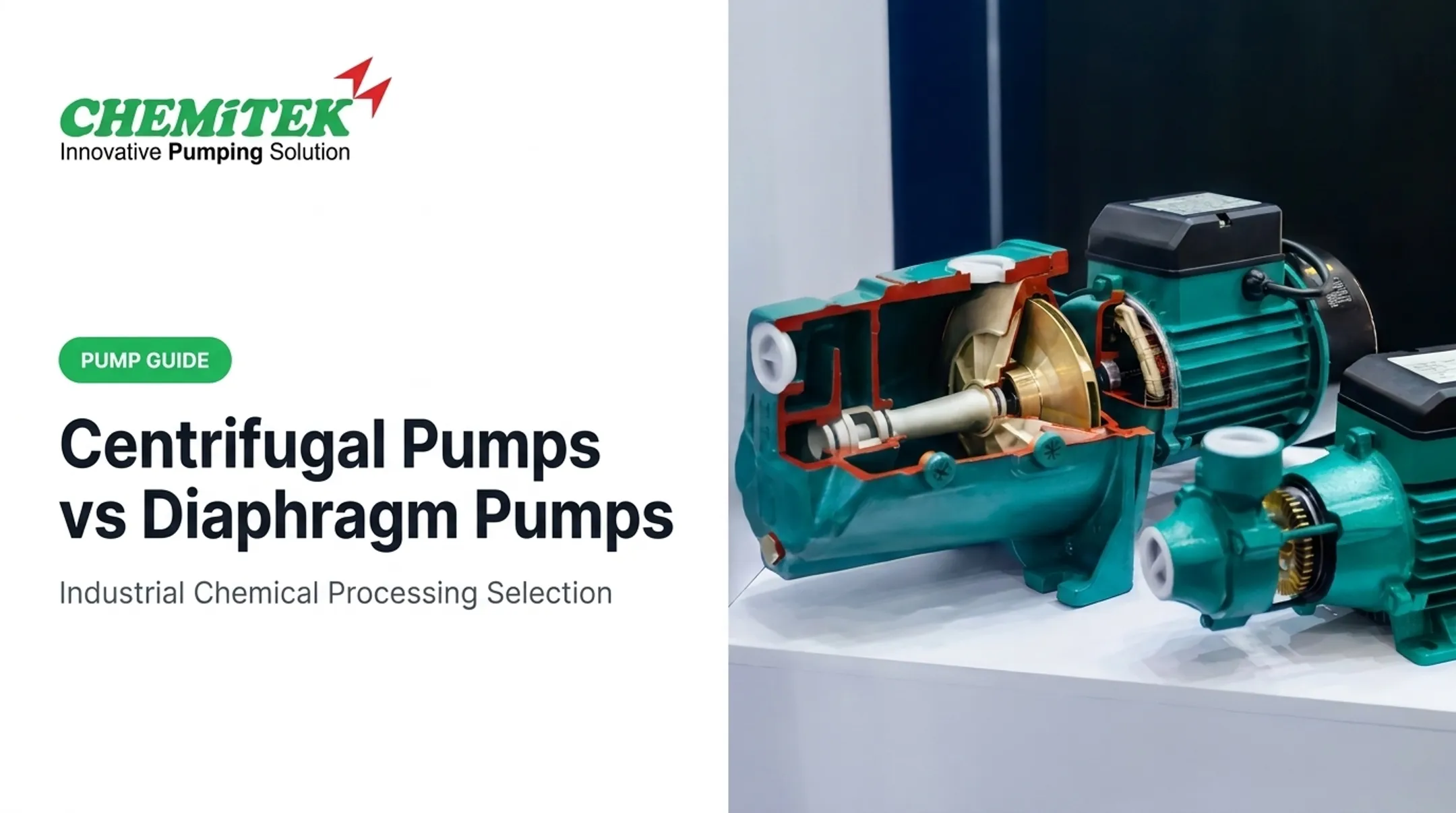
A centrifugal pump is a rotodynamic pump. The impeller transfers energy to the liquid, and the casing turns velocity into useful pressure. It suits continuous transfer, high-volume circulation, and compact installations. Maintenance is straightforward.
Materials and Containment
For corrosive duty, wetted materials matter as much as hydraulics. Published limits are model-specific, so check the manufacturer's chemical and temperature data:
- Polypropylene and PVDF: one manufacturer rates its models to 180°F (82°C) and 220°F (104°C) respectively.
- PTFE- or PFA-lined designs: one magnetic-drive range spans -80°F to +400°F.
- Alloy 20, duplex stainless and Hastelloy: grade and concentration limits vary.
API 682 covers shaft-sealing systems for hazardous, flammable or toxic service.
Common Variations
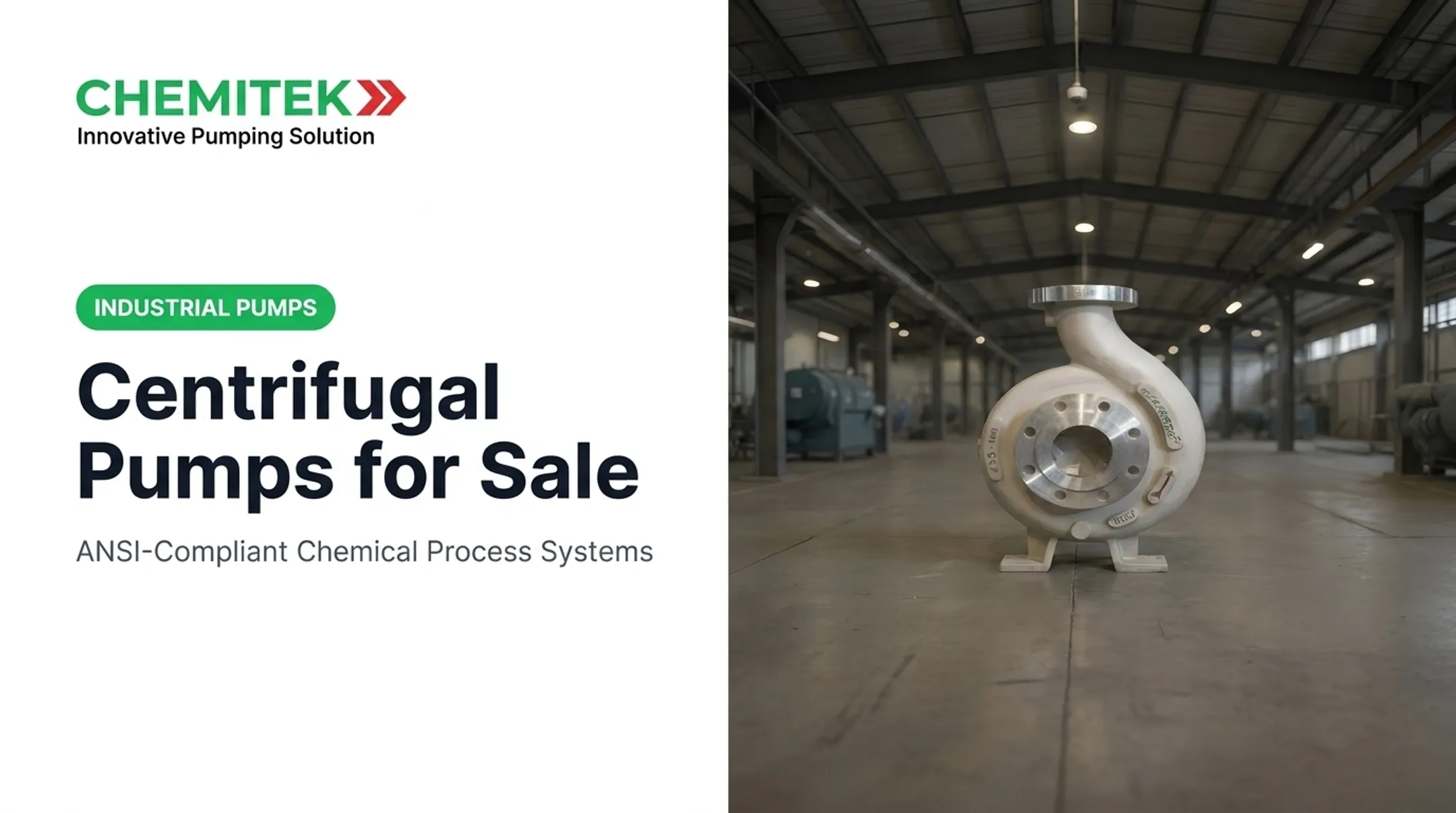
- End-suction: horizontal, single-stage design under ASME B73.1 (metallic or solid polymer).
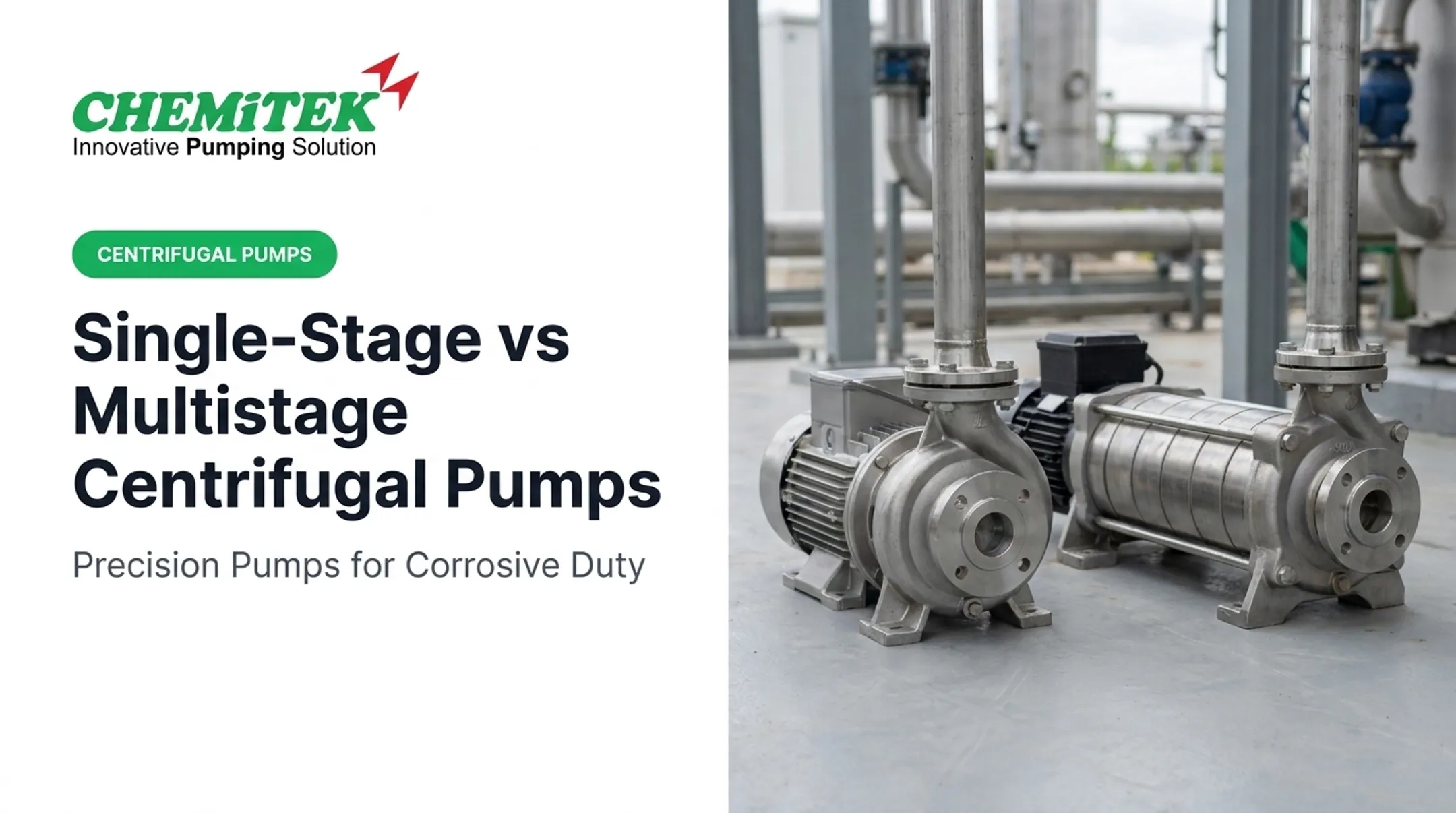
- Multistage: impellers in series raise head at unchanged flow.
- Self-priming: evacuates suction-line air.
- Vortex: free-flow impeller reduces clogging in wastewater and pulp.
- Magnetic-drive: sealless containment for corrosive or toxic media.
Chemitek builds metallic and non-metallic horizontal centrifugal pumps, with non-metallic options in PVDF, PFA, FEP and polypropylene.
Use Cases of Centrifugal Pumps
Typical applications include industrial processing, cooling, municipal water and wastewater, boiler and utility service, and chemical transfer.
A centrifugal is a strong fit when you have:
- High or steady flow
- Relatively low viscosity
- Moderate pressure
- Adequate suction conditions
- Continuous operation
For corrosive service, a custom-designed centrifugal can use compatible metallic or polymer wetted parts. Chemitek designs ANSI/ASME B73.1-compliant horizontal process pumps for acids, alkalis and toxic liquids, with flow up to 1,400 m³/hr and temperatures up to 350°C (metallic) or 210°C (non-metallic). B73.1 dimensional interchangeability also simplifies spare parts sourcing.

What Is a Positive Displacement Pump?
A positive displacement (PD) pump traps a known volume of fluid and forces it from the inlet to the discharge. Rotary designs move a fixed volume per revolution. Reciprocating designs move it per stroke.
Benefits
- Comparatively stable flow
- High-pressure capability
- Metering and dosing potential
- Suction lift in many designs
- Handling of thick fluids
Common Subtypes
| Subtype | Typical fit |
|---|---|
| Gear | Inks, resins, starch; some models handle 3–55,000 cSt |
| Screw | Low- to high-viscosity media, gentle transport |
| Lobe | Hygienic, shear-sensitive fluids |
| Vane | Corrosive liquids, acids, brines, syrups |
| Progressive cavity | Abrasive products, dewatered sludge |
| Peristaltic | Abrasive, aggressive, shear-sensitive media |
| Diaphragm | Toxic, abrasive, or viscous liquids |
| Piston/plunger | Precision dosing |
Limitations
- Abrasive wear enlarges clearances and increases slip, especially at higher pressure and lower viscosity
- Some reciprocating designs pulsate
- Elastomers and wetted materials must match the fluid
- Relief protection is essential
Use Cases of Positive Displacement Pumps
Common applications include:
- Chemical dosing
- High-viscosity oils, polymers, and pastes
- Sludge and adhesives
- Food products
- Processes that need repeatable delivery
Consider a positive displacement (PD) pump when you face:
- High viscosity
- Low-to-moderate flow
- High discharge pressure
- Accurate metering
- Suction lift
- Low shear
- Flow that must hold steady as pressure changes

PD is a broad category, so choose the subtype by solids content, allowable shear, pulsation tolerance, sanitary needs, viscosity, pressure, temperature, and maintenance access.
Centrifugal vs Positive Displacement Pumps: What Is Better?
There is no universal winner. Start with the fluid, flow, discharge pressure, suction conditions, temperature, solids, corrosiveness and operating schedule.
- Choose centrifugal for high-volume transfer of low-viscosity liquids when the system can run within the pump curve and no fixed-volume metering is needed.
- Choose PD for viscous or shear-sensitive fluids, high-pressure/low-flow duties, suction lift or dosing where flow stability is critical.
Efficiency at the Duty Point
Compare efficiency where the pump will actually run. Best Efficiency Point (BEP) is a centrifugal's highest-efficiency point. Throttling dissipates energy as non-useful work, while variable-speed control can avoid throttling losses, particularly in friction-dominated systems.
High-static-head systems need separate analysis because slowing the pump can push it toward shutoff.
Viscosity cuts both ways: it harms centrifugal performance but can reduce PD slip, while raising PD inlet-pressure and power demands. Separate hydraulic efficiency from lifecycle cost when you weigh options.
Selection Checklist
- Fluid name and composition
- Viscosity at operating temperature
- Specific gravity
- Corrosiveness
- Solids size and concentration
- Target flow and discharge pressure
- Suction lift and NPSH available
- Temperature
- Seal requirements and materials
- Power supply
- Required control accuracy
Combined Systems
Sometimes both belong in one plant. A Grundfos reverse-osmosis installation pairs a multistage centrifugal pump for RO pumping with a diaphragm dosing pump for chemicals. Have a qualified pump engineer validate the full piping and control arrangement.
Real World Examples/Case Studies
Weir and Codelco Ventanas
Corrosive, high-temperature sulfuric acid caused pump leakage and failure at Codelco's Ventanas operation, with weekly disruptions. A new layout with externally mounted vertical sulfuric-acid pumps delivered these results:
- 12 months of operation before stopping for preventive maintenance
- 200 fewer maintenance hours per year
- More than $100,000 saved annually on replacement parts
The 12-month interval is an operating period, not a stated MTBF. Weir's case involved a vertical design, not a horizontal one, so treat it as a lesson about matching mechanics and materials to the duty.
A Chemitek Hot-Acid Example
An unnamed ethyl-chloride producer recirculated a hydrochloric-acid/ethanol solution at 142°C. After switching to a Chemitek NM Series pump, motor current fell from 50 A to 26 A. Current alone is not a measure of energy use, and maintenance or MTBF figures were not published for this installation.
The Lesson
Buy for the duty, not the purchase price. If your application points to a corrosion-resistant centrifugal process pump, contact Chemitek for a custom application review.
Conclusion
Centrifugal pumps suit high-flow, low-viscosity transfer. PD pumps fit viscous, metered, shear-sensitive, suction-lift or high-pressure duties. Match the pump type to the duty rather than treating either as a default.
Before you select, compare:
- Fluid properties and system curve
- Pressure, temperature and solids
- Materials and safety controls
- Maintenance needs and lifecycle cost
Frequently Asked Questions
What is the difference between centrifugal and positive displacement pumps?
Centrifugal pumps use an impeller to add velocity, which becomes pressure. PD pumps trap a fixed volume and move it mechanically. Centrifugals favor high flow and thin liquids; PD pumps favor viscous fluids and steady flow.
How to tell if a pump is centrifugal or positive displacement?
Check the pump's mechanism: an impeller means centrifugal, while gears, lobes, pistons, diaphragms or a screw mean PD. Documentation, model type and the performance curve confirm it. A falling head-flow curve points to centrifugal.
When to use a positive displacement pump?
Use PD for viscous fluids, high-pressure/low-flow service, dosing, suction lift, shear-sensitive products and duties needing flow that holds steady as pressure changes.
Which type of pump is more efficient?
Neither, universally. Efficiency depends on the duty point, viscosity, pressure, speed, control method and system design. A centrifugal on thin liquid near BEP is efficient; on viscous fluid it may not be.
Is a centrifugal pump a positive displacement pump?
No. A centrifugal pump is rotodynamic. It creates flow by imparting velocity to the liquid rather than trapping a fixed volume.
Are PD pumps self-priming?
Many rotary PD pumps can self-prime or lift from suction, but it varies by subtype, fluid, viscosity, suction piping, seals and manufacturer limits. Self-priming doesn't permit dry running.