
Introduction
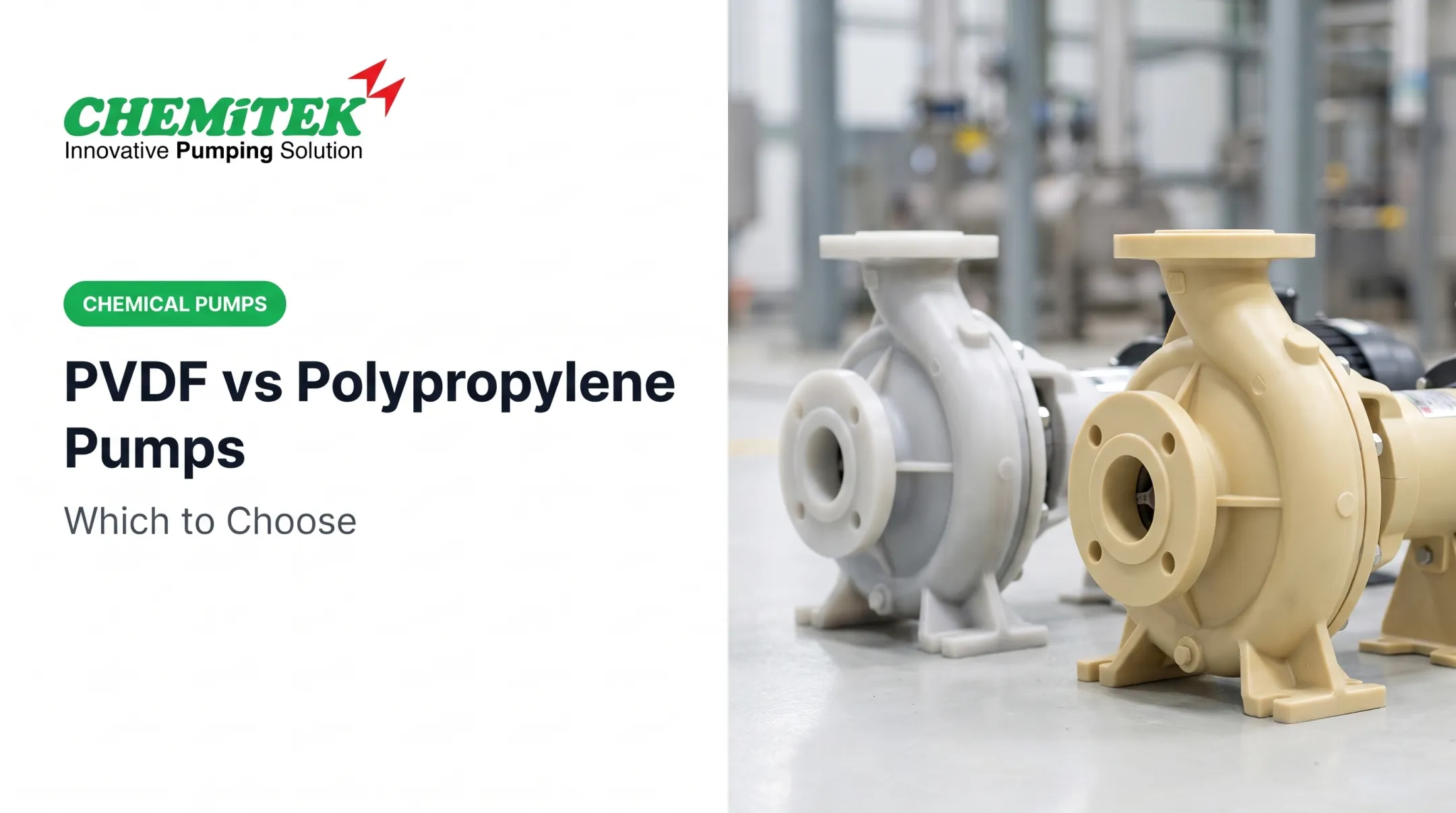
PFA and PVDF both show up on spec sheets for aggressive acid service. "Chemical resistance" alone won't tell you which one is safer or cheaper over the life of the pump.
NACE's IMPACT study puts global corrosion costs at $2.5 trillion, or 3.4% of 2013 global GDP.
Pump-level data is narrower but telling: Grundfos, citing a 2002 OMV dataset, attributes 39% of pump failures and 44% of repair costs to mechanical seals.
For chemical processing, steel pickling, fertilizer, pharmaceutical, and water-treatment plants across the US, the wrong wetted material means leaks, downtime, and early replacement. This article covers acid type, temperature, pressure, solids, construction, seals, and lifecycle cost.
Key Takeaways
- PFA and PVDF are both fluoropolymers, but they trade off chemical scope, temperature, strength, and cost differently.
- PFA suits severe, mixed-acid, or high-purity duty; PVDF suits compatible duty where mechanical robustness matters.
- Concentration, temperature, contaminants, solids, and pump design can flip the recommendation.
- Judge by lifecycle performance, not material price.
PFA vs PVDF Pumps: Quick Comparison
Treat every figure below as a starting point. Verify ranges against the manufacturer's datasheet and your exact acid chemistry.
| Factor | PFA | PVDF |
|---|---|---|
| Resin continuous temperature | 500°F (PFA 350) | Up to 302°F (Solef) |
| Tensile strength at 73°F | 4,000 psi | 4,400-7,300 psi (homopolymers) |
| Impact | Notched Izod "No Break" | Notched Charpy 0.7-10 ft-lbf/in |
| Typical pump form | Often a liner in a structural casing | Often solid molded wetted parts |
| Acid limits | Broad, with exceptions | Set by acid, concentration, and grade |
Sources: Chemours and Solvay data. The impact tests and tensile grade populations differ, so this is not a controlled head-to-head benchmark.
Cost and total cost of ownership
Neither material carries a fixed, published price premium across pump lines. Munsch describes PVDF as an application-dependent economical alternative to its PTFE/PFA option. Count seal replacement, spares, downtime, and energy alongside purchase price.
Composition and pump construction
- Solid PVDF: Vanton makes fluid-contact parts from solid thermoplastics, so protection doesn't depend on a thin coating.
- PFA-lined: Flowserve's PolyChem S has a PFA-lined wet end inside structural armor. The liner resists chemicals; the armor carries the mechanical load.
- Component-level: Some designs use PVDF only for parts such as shaft sleeves. Check each wetted component separately.
Chemical durability, thermal limits, and fit
Resin ratings are not pump ratings. PFA resin reaches 500°F, yet the PFA-lined PolyChem S lists 300°F maximum. PVDF resin reaches 302°F, while Munsch's PVDF pump lists up to 257°F.

Seals, bearings, shaft materials, and hydraulics matter as much as the casing polymer.
What Are PFA and PVDF Pumps?
What Is a PFA Pump?
PFA is perfluoroalkoxy, a copolymer of tetrafluoroethylene and perfluoroalkyl vinyl ether. In pumps it may appear as a liner, casing, impeller, seal part, or other wetted component. A "PFA pump" is not always made entirely of PFA.
Its value in acid service:
- Chemical inertness: Chemours immersion tests show roughly 93-99% tensile retention with 0.0% weight gain in concentrated sulfuric, hydrochloric, nitric, and phosphoric acids, and 60% HF.
- Purity: Grades such as PFA 450HP target ultra-high purity with lower extractable fluorides.
- Processability: PFA can be injection molded and screw extruded, unlike PTFE.
Chemours also notes PFA exceptions, including certain fluorine-containing complexes, alkali metals, metal hydrides, and some amines at elevated temperatures. PFA also cold-flows under sustained stress, even below yield.
Use Cases of PFA Pumps
PFA fits severe or high-purity transfer, concentrated acids, mixed streams, and services where a leak is costly. Limits include mechanical load, creep, thermal cycling, abrasion, and price.
Solids are a design question. CP's PFA-lined EB pump uses an open impeller for solids-containing fluids, but handling is subject to technical clarification.
Dry running is not covered by chemical resistance. CP's EB uses a double mechanical seal with barrier fluid to lubricate the seal faces.
What Is a PVDF Pump?
PVDF is polyvinylidene fluoride, widely used in non-metallic pumps, piping, and liners. It balances chemical resistance with mechanical strength, and Arkema cites its resistance to tensile creep and fatigue.
Concentration and temperature change the answer. Arkema's homopolymer chart limits sulfuric acid to 250°F up to 60%, 200°F at 60-93%, and 125°F at 94-98%.
Nitric acid is limited to 175°F up to 10% and 125°F at 11-70%, and fuming nitric is not recommended. Oleum is not recommended for any listed PVDF grade. Arkema also warns that its maxima do not account for mixtures.

Use Cases of PVDF Pumps
PVDF fits acid transfer, steel pickling, chemical processing, water and wastewater treatment, fertilizer, and specialty chemicals, when the full envelope matches.
Two documented examples:
- Kaneka Texas: An all-PVDF centrifugal pump circulates 1.5% hydrochloric acid through a scrubber at 340 gpm and 85 ft TDH. Installed in July 2008, it was reported in March 2013 as running without interruption beyond a planned monthly shutdown. The author is Vanton's president, so this is supplier-authored evidence.
- Entergy: A PVDF wetted-end pump handles ambient-temperature sulfuric acid at 20 gpm and 55 ft TDH. Good early records prompted a wider thermoplastic pump replacement program, though no life or cost figures were published.
Chemitek's first major order in 2012 was for PVDF pumps in steel pickling.
PFA vs PVDF Pumps: What Is Better?
Neither is universally better. The answer depends on the fluid, operating envelope, pump construction, and consequences of failure.
Acid chemistry
Before you choose, pin down the exact acid or mixture, concentration, impurities, oxidizing or reducing conditions, and exposure time. Acid names alone mislead. PVDF's limits swing from 250°F to 125°F within sulfuric acid depending on strength.
For mixed acids, PFA is often the safer starting point, since PVDF charts explicitly exclude mixtures. Still, qualified mixed-acid test data for PFA is often limited, so confirm suitability with the manufacturer.
Temperature and thermal cycling
Continuous temperature, start-up and shutdown cycles, hot spots, and exothermic reactions all affect compatibility, creep, deformation, and seal life. Validated assembled-pump thermal-cycle limits are rarely published for either polymer, so request them from the manufacturer. Reinforced casing walls and armor help resist deformation.
Hydraulic and mechanical demands
A compatible polymer still fails in a misapplied pump. Review:
- Flow, differential pressure, and suction conditions
- Solids content and abrasion
- Vibration and dry-running risk
- Continuous versus intermittent duty
Lifecycle economics
The DOE life-cycle cost guide counts acquisition, installation, energy, maintenance, downtime, and disposal. No authoritative PFA-versus-PVDF MTBF or lifecycle figures are published, so compare costs against your own duty.
Situational recommendations
- Choose PFA or PFA-lined when verified chemical or temperature severity, purity needs, or failure consequences justify it.
- Choose PVDF when verified compatibility is adequate and strength or practical construction helps.
- Get an application review for mixed acids, high temperature, suspended solids, pressure swings, or uncertain data.
Chemitek builds custom-engineered, non-metallic centrifugal pumps, with PVDF, PFA, and FEP construction options in its NM Series. Its engineers can review your full duty point and wetted-material configuration.
Real-World Examples/Case Studies
The best-documented example is the Kaneka Texas PVDF installation described above.
The challenge: Circulate dilute hydrochloric acid through a venturi scrubber and packed tower, continuously.
The decision: All wetted components injection molded from PVDF, with a single mechanical seal and external water flush.
The result: Over roughly five years, the pump ran without interruption other than planned shutdowns. MTBF, temperature, and savings figures for this install are not publicly available.
What transfers: Similar dilute, moderate-temperature halogen acid duty.
What doesn't: Concentrated, hot, oxidizing, or mixed acids, where PVDF limits tighten and PFA deserves a look. This example doesn't prove PVDF beats PFA.
Share your acid type, concentration, temperature, flow, head, solids, and duty cycle with Chemitek for an application review.
Conclusion
PFA is the stronger candidate for verified severe chemical, temperature, or purity demands. PVDF is the better fit when its compatibility is adequate and mechanical durability and practical construction matter.
Base the final choice on exact process data and the whole pump assembly, not the polymer name. Validate it with compatibility charts, pump curves, seal specifications, and application engineering support.
Frequently Asked Questions
Is PFA the same as PTFE?
No. Both are fluoropolymers with strong chemical resistance, and PFA is structurally close to PTFE. PFA can be conventionally injection molded and extruded, while PTFE has processing limits.
Is PVDF stronger than PVC?
PVDF is generally tougher and tolerates higher temperatures: Vanton lists 275°F for PVDF versus 140°F for PVC. PVC resists many acids too, so verify grade and service conditions.
What is a PVDF pump?
A PVDF pump uses PVDF in its wetted components or construction. It's chosen for compatible corrosive-fluid service where strength and chemical resistance both matter.
Can PFA handle aggressive acids?
Often, yes. Chemours tests show broad resistance, including concentrated sulfuric, hydrochloric, and nitric acids. Suitability still depends on acid, concentration, temperature, exposure time, grade, and pump configuration.
Is PFA better than PVDF for high-temperature acid service?
PFA may offer an advantage in hot or chemically severe duty, while PVDF can suit lower or moderate conditions. Verify against the pump's own rated limits, which are lower than resin limits.
How do I choose between a PFA and PVDF pump?
Gather acid chemistry, concentration, temperature, flow, head, pressure, solids, duty cycle, seal needs, and failure consequences. Then request an engineered comparison rather than a material-only decision.