
Introduction
A pump that handles a corrosive chemical fails in ways that spread. The casing thins, the seal leaks, the product picks up contamination, and the line goes down.
Corrosion costs are large at the macro level. NACE's IMPACT study put global corrosion cost at $2.5 trillion, or 3.4% of 2013 global GDP. That figure covers all industries, not pumps alone, but it shows the scale of the problem.
At the pump, the damage looks like leaking packing, eaten baseplates, and seals that never reach their expected life. An unsuitable material drives unplanned downtime, higher spares consumption, and replacement costs.
This guide covers how to specify materials for every wetted and sealing part, which variables matter, and how to document the decision.
Key Takeaways
- Select materials for the chemical, concentration, temperature, pressure, and solids, not the chemical name alone.
- Check every wetted and sealing part: casing, impeller, sleeve, seal, gaskets, elastomers.
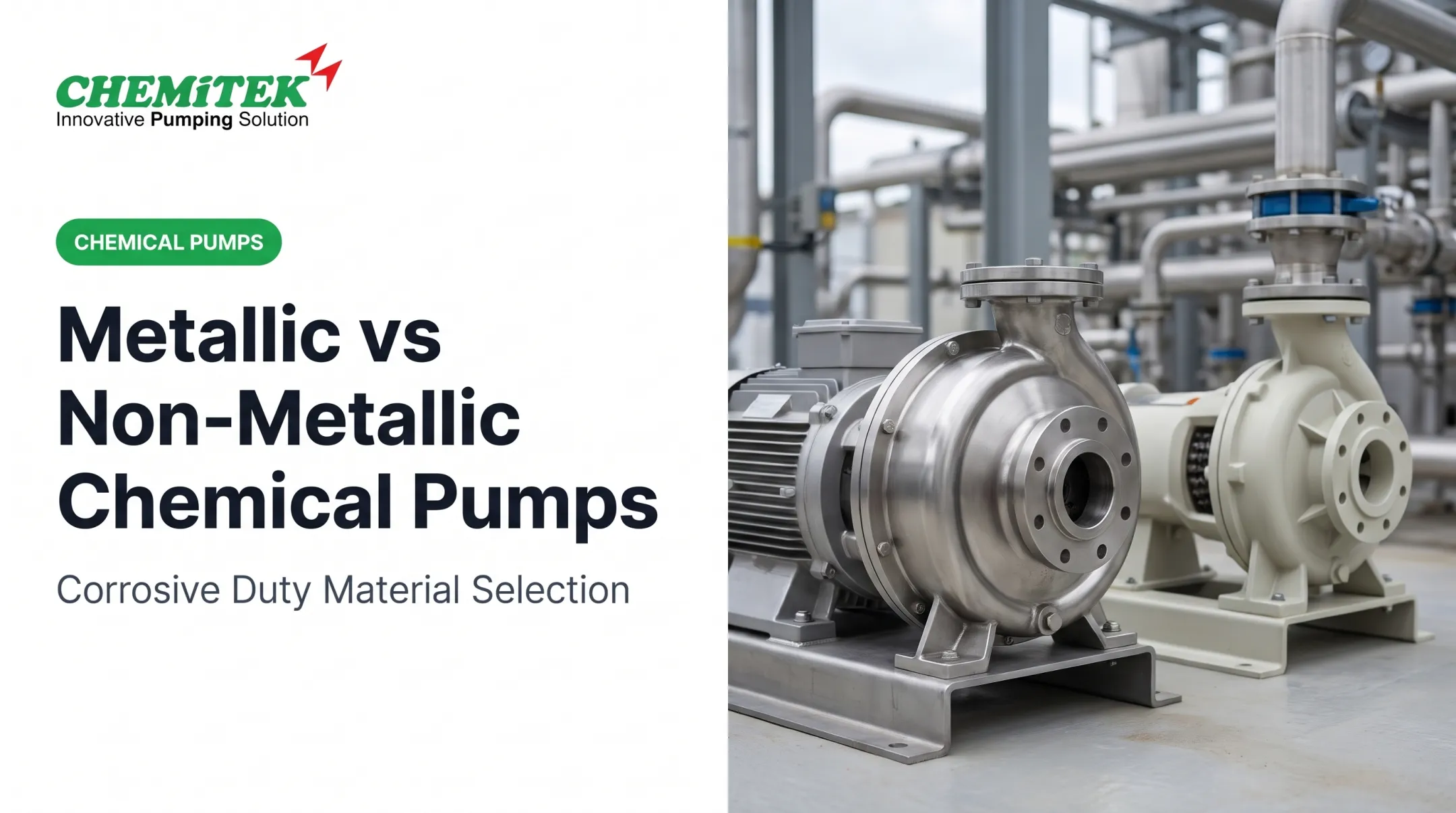
- Metallic, solid-polymer, and fluoropolymer-lined pumps each fit different duties.
- Use compatibility charts as a first screen, then confirm with the manufacturer.
- Compare options on lifecycle outcomes: leakage, MTBF, maintenance, and downtime.
What Is Pump Material Selection for Corrosive Chemicals?
Pump material selection for corrosive chemicals is the process of specifying materials that can contain, move, and withstand a corrosive chemical for the pump's intended life. The specification is made part by part, not once for the whole pump.
Wetted parts touch the process fluid, so chemical compatibility must be checked for each. Non-wetted parts do not, but they still need mechanical strength and resistance to the plant environment.
Types of pump construction for corrosive service
Three construction families cover most chemical duties:
- Metallic: Stainless steel, duplex, Alloy 20, Hastelloy, nickel, and titanium are common alloy options. A manufacturer's alloy list is an availability list, not a resistance ranking.
- Solid polymer: Casings and impellers in PP, PE-UHMW, or PVDF. These often carry external metal armor for pressure and piping loads, so "non-metallic" does not mean no structural metal.
- Lined: A metal pressure shell with a PTFE or PFA wetted barrier. The shell and the barrier are separate specifications.
Polymer names alone do not set a temperature limit. A Tapflo brochure lists 158°F (70°C) for PP and 194°F (90°C) for PVDF on its pumps. Other models, including PFA-lined designs, publish different envelopes. Always check the specific pump.

Stainless is not a universal answer. Chlorides are the most common cause of stress corrosion cracking in stainless, and no grade is totally immune. Weaker sulfuric acid is often more corrosive to most metals than the concentrated form.
Core components of a chemical-process pump
- Casing: retains pressure and keeps process fluid from the atmosphere.
- Impeller: transfers energy to the fluid. It must suit the chemical and also the speed, head, flow, and solids load.
- Shaft sleeve: protects the shaft from mechanical wear and chemical attack.
- Mechanical seal, gaskets, elastomers: stop leakage and protect the drive end.
- Bearings and power frame: normally outside the fluid path.
Seals deserve their own review. A casing can be perfectly suited while the seal fails. Common seal materials include silicon carbide, carbon or graphite, PTFE, FKM, EPDM, and FFKM.
Each has limits: EPDM handles caustics and many acids but not hydrocarbons, while PTFE has exceptions such as alkali metals and fluorine. Confirm each against the actual chemical, temperature, pressure, and wear conditions.
Benefits of correct material selection
- Controls corrosion and lowers leakage risk
- Extends component life and keeps efficiency stable
- Cuts maintenance and spares consumption
- Improves worker and environmental safety
- Reduces unplanned downtime
What to Consider When Choosing the Best Pump Materials for Corrosive Chemicals
Treat the following as a specification checklist. Each item can change the answer.
Start with complete chemical and process data
Document the exact chemical, concentration range, pH, impurities, oxidizing or reducing behavior, and chloride content. Note whether operation is batch or continuous.
Resistance changes with concentration and temperature, and materials suitable for individual chemicals can be damaged when those chemicals are mixed. Compatibility guides often disclaim accuracy and leave verification to the user, so confirm with the supplier.
For stainless steel, chloride detail matters. Evaporation can concentrate a few ppm in bulk solution to hundreds of ppm locally.
Temperature, pressure, and process transients
Record normal and maximum temperature, thermal cycling, vacuum, start-up and shutdown, and pressure surges. Temperature changes both corrosion resistance and mechanical strength.
Steady-state ratings are not cycle-life data. Seal assemblies add their own limits: one published carbon-and-SiC seal is rated -40 to 225°F (-40 to 107°C), with derating factors applied.
Solids, abrasion, viscosity, and flow behavior
Suspended solids, crystallization, abrasive particles, viscosity, gas entrainment, and cavitation all affect the impeller, casing, and seal. Solids concentration, size, and hardness feed directly into the material choice.
Cavitation is worth special attention. Microjets from collapsing vapor bubbles can destroy material through concentrated pressure surges, so compare NPSH available against NPSH required.
Pump type and hydraulic duty
Match flow, total head, NPSH available, speed, and duty cycle to the construction. A chemically compatible pump still fails if it is hydraulically misapplied. Track efficiency, vibration, reliability, and capacity as KPIs.

Compatibility of every wetted and sealing component
Walk through this list:
- Casing and liners
- Impeller
- Shaft or shaft sleeve
- Seal faces and stationary seats
- O-rings and gaskets
- Bushings
- Auxiliary piping
The weakest incompatible part sets the reliability of the whole pump.
Lifecycle, safety, compliance, and maintainability
Purchase price is only one line. A DOE and Hydraulic Institute guide notes that initial purchase is a small portion of cost for high-usage pumps, with energy often dominating above 2,000 operating hours a year. Lifecycle costing also covers maintenance, downtime, contamination, and disposal.
Weigh repairability, spare-parts availability, containment needs, and plant standards alongside price. For covered processes, OSHA's 29 CFR 1910.119 requires management of change, except replacements in kind. A different concentration or formulation may not qualify as a replacement in kind.
Record the final material of construction, operating envelope, compatibility sources, inspection requirements, and change-control process. Then a later shift in concentration, temperature, or formulation will not silently invalidate the original selection.

How Chemitek Can Help
Chemitek, founded in 2009, makes custom-designed horizontal centrifugal process pumps for corrosive acids, alkalis, and toxic liquids. The company supplies both metallic and non-metallic pumps, with four premium polymer options, investment-cast wetted parts, heavy-duty power frames, and ANSI/ASME B73.1-compliant designs.
Features to discuss with their engineers:
- TruTrapezoid™ volute casing with open impeller design
- PolyCart™ mechanical seal
- PolyGrif™ armored casing or backplate
- PolyPrime™ fluoropolymer priming pot
- CorroSmart™ pumps for batch processes
Ask only about configurations confirmed for your duty. Stated capability reaches 1,400 m³/hr, 210°C for non-metallic pumps, and 350°C for metallic pumps. Final suitability still depends on chemical compatibility, concentration, pressure, solids, and hydraulics.
When requesting a recommendation, send:
- Chemical name and concentration
- Temperature range
- Flow and head
- Solids content
- NPSH available
- Operating cycle
- Seal requirements
That data beats selecting by material label alone.
Conclusion
The right material matches the full chemical and operating envelope. Cost, common use, or corrosion resistance alone do not decide the choice.
Evaluate the casing, impeller, shaft protection, seals, gaskets, and auxiliary wetted parts together, then verify with reliable compatibility and application data.
Review the selection whenever formulation, concentration, temperature, throughput, or process conditions change. Material choice is an ongoing reliability and safety decision.
Frequently Asked Questions
What materials are pumps made of?
Common options include cast iron, stainless steel, duplex, nickel alloys, PP, PVDF, PTFE or PFA linings, ceramics, elastomers, and composites. The right choice depends on the chemical, concentration, temperature, pressure, solids, and component function.
What materials are pump impellers made of?
Impellers use stainless or other alloys, cast metals, polymers such as PP and PVDF, or fluoropolymer-based construction. The choice depends on corrosion, erosion, temperature, hydraulic loading, and solids.
What are the major parts of a water pump?
The casing, impeller, shaft, shaft sleeve, mechanical seal, bearings, driver, suction and discharge connections, and power frame. In chemical service, every wetted and sealing part needs a compatible material.
What is a 5-stage pump?
It passes fluid through five impellers in series to build higher head. Stage count addresses hydraulic duty, while material selection addresses chemical compatibility.
How do I choose a pump material for a corrosive chemical?
Document the chemical, concentration, temperature, pressure, solids, flow, head, and operating cycle. Then verify compatibility for every wetted and sealing component with a qualified pump supplier.
Is stainless steel suitable for all corrosive chemicals?
No. Suitability depends on the chemical, concentration, temperature, impurities, chloride exposure, and mechanical conditions. Check the specific grade against reliable compatibility data.